Innovation

Built on national-level R&D platforms, Kingenta keeps driving breakthroughs in new fertilizers and nutrient-use efficiency, so that innovation truly serves sustainable agriculture worldwide.

R&D system and platforms

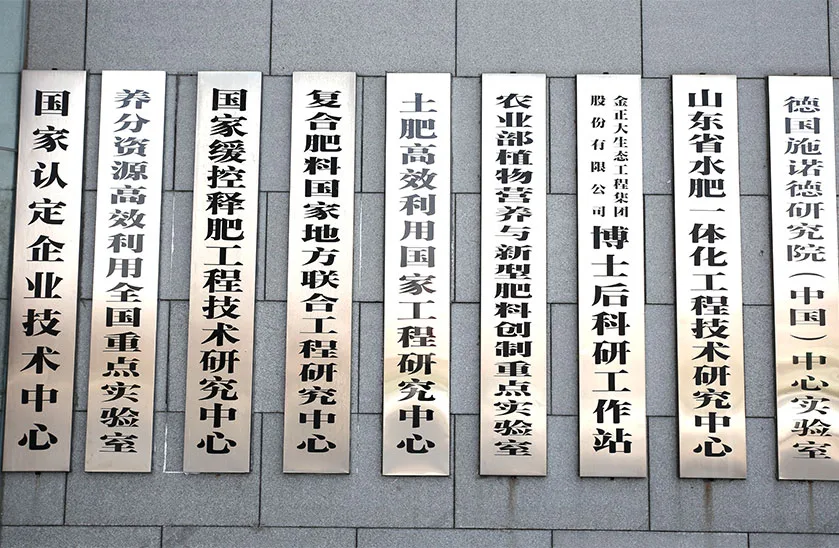
The Kingenta Research Institute integrates basic research, engineering translation, quality testing, standard setting, new-product development and application demonstration for premium fertilizers, including slow- and controlled-release fertilizers, nitrate-based fertilizers, water-soluble fertilizers, liquid fertilizers, biological fertilizers and biostimulants, forming a high-level technology innovation platform.

Kingenta Group has a dedicated R&D unit, the Kingenta Research Institute, with more than 100 researchers, over 20,000 square metres of research space, more than 360 advanced laboratory instruments and more than 40 sets of pilot-scale equipment.

Kingenta Research Institute
1Kingenta Research Institute
2National key laboratories
3National engineering research centers
2Innovation alliances
Key laboratory

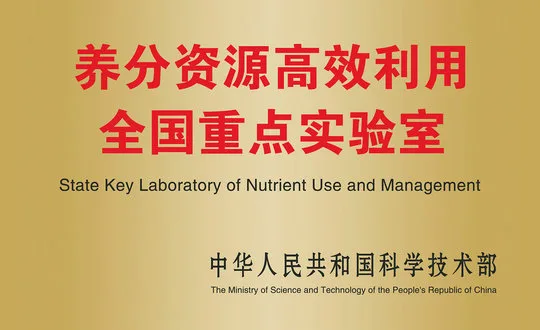
State Key Laboratory of Efficient Utilization of Nutrient Resources

Basic and strategic research on efficient nutrient utilization.

Key laboratory

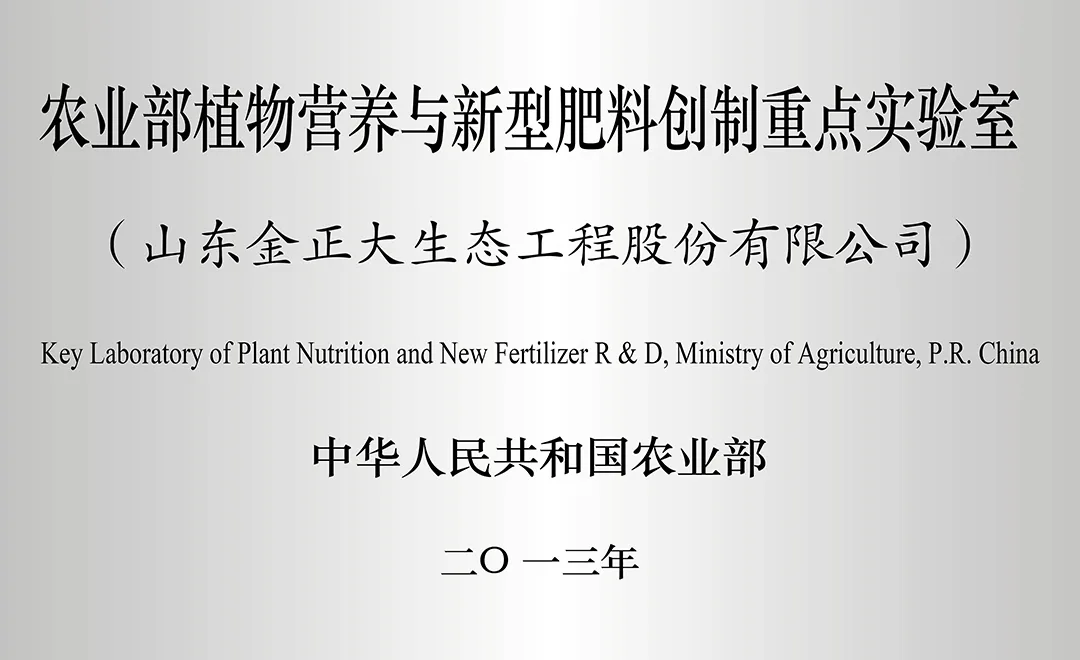
Key Laboratory of Plant Nutrition and New Fertilizer Development, Ministry of Agriculture and Rural Affairs

Research on plant nutrition and new fertilizer development.

National engineering research centers

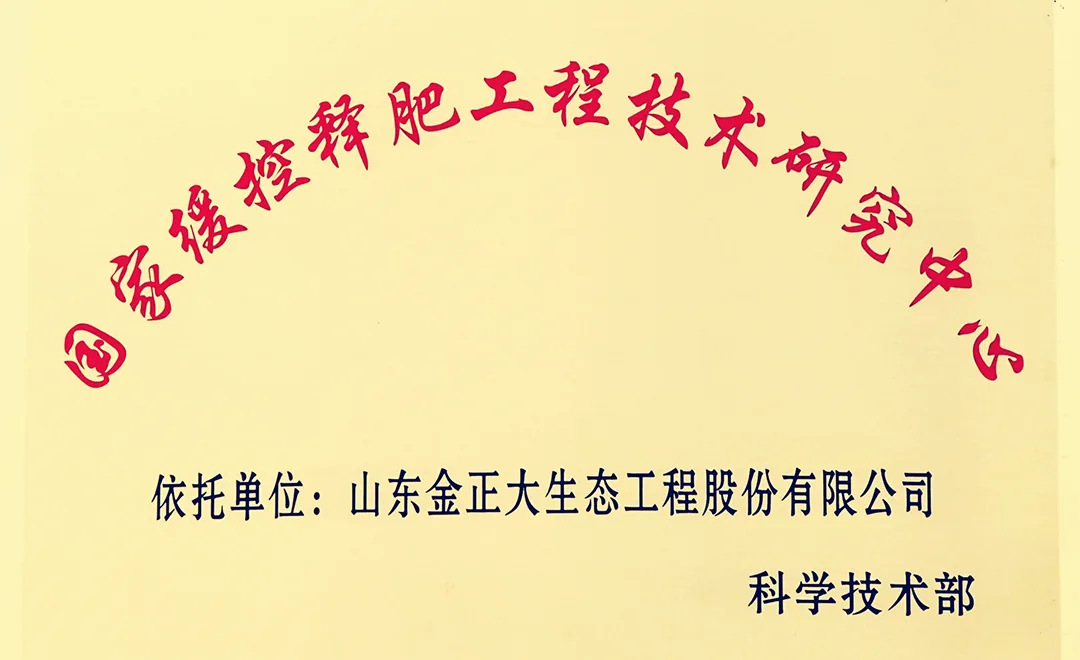
National Engineering Research Center for Slow/Controlled-Release Fertilizers

Engineering and industrialization of slow- and controlled-release fertilizers.

National engineering research centers

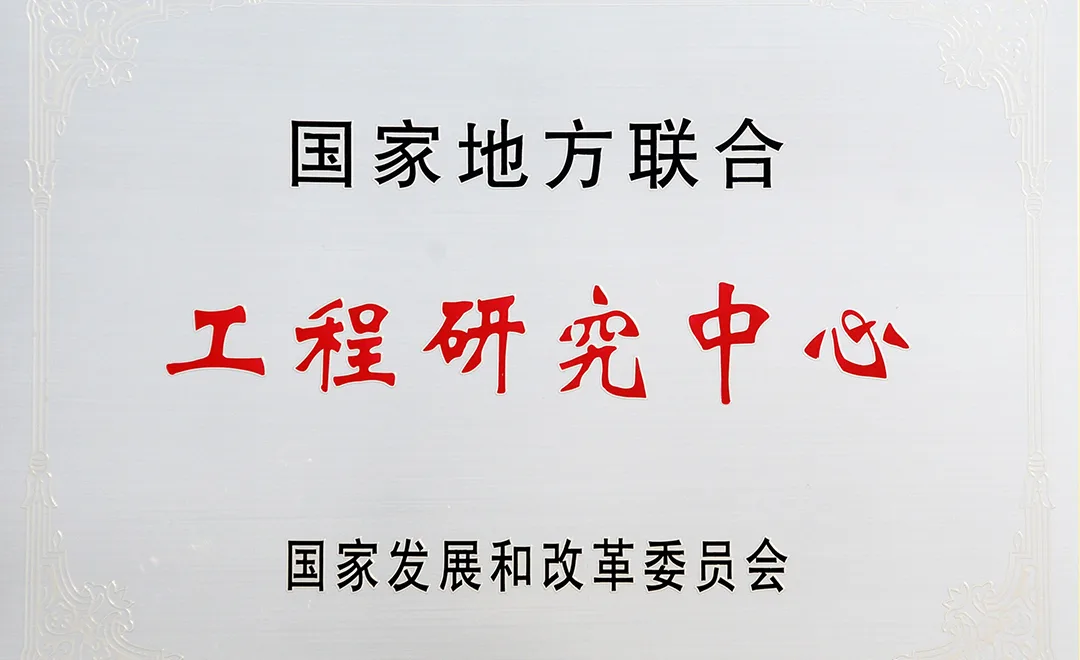
National Engineering Research Center for Compound Fertilizers

Engineering research on compound fertilizers.

National engineering research centers

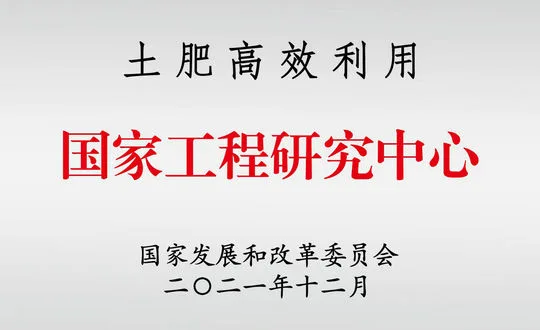
National Engineering Research Center for Efficient Utilization of Soil and Fertilizer

Research on efficient use of soil and fertilizer.

Other innovation platforms

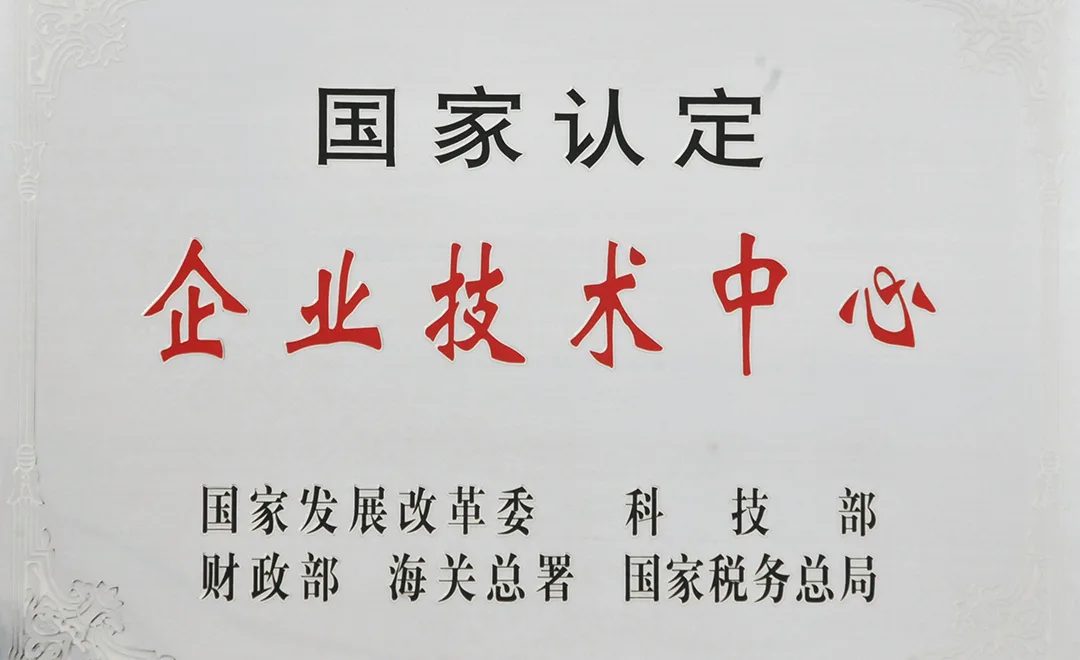
National Recognized Enterprise Technology Center

Core technology R&D for the enterprise.

Other innovation platforms

Postdoctoral research workstation

Training of top talent and research breakthroughs.

Other innovation platforms

Shandong Engineering Research Center for Integrated Water and Fertilizer Management

Research on fertigation technology.

Other innovation platforms

Guizhou Engineering Research Center for Clean Production in Phosphorus Chemical Industry

Clean production in the phosphorus chemical industry.

Other innovation platforms

Guizhou Engineering Research Center for Efficient Use of Phosphorus and Potassium Nutrients

Efficient use of phosphorus and potassium nutrients.

Other innovation platforms

Henan Engineering Laboratory for Efficient Utilization of Soil and Fertilizer Resources

Efficient utilization of soil and fertilizer resources.

Innovation alliance

Industrial Technology Innovation Strategic Alliance for Slow/Controlled-Release Fertilizers

Collaborative innovation across the industry.

Innovation alliance

National Agricultural Science and Technology Innovation Alliance for High-Efficiency Compound Fertilizers

Collaborative agricultural science and technology innovation.

State Key Laboratory of Efficient Utilization of Nutrient Resources

State Key Laboratory of Efficient Utilization of Nutrient Resources

Approved and established by: Ministry of Science and Technology

Laboratory director: Zhang Fusuo, Academician of the Chinese Academy of Engineering

Founding institutions: Shandong Academy of Agricultural Sciences, China Agricultural University, Kingenta Ecological Engineering Group Co., Ltd.

Research focus: mechanisms of efficient nutrient resource utilization, key technologies and equipment for nutrient resource management, development of new green fertilizers, and technical models and applications for efficient nutrient use

The laboratory has 200 permanent staff, including 174 researchers, 20 technicians and 6 administrators; 155 researchers hold associate-senior titles or above, including 1 Academician of the Chinese Academy of Engineering, 2 Distinguished Professors of the Changjiang Scholars Program, 4 recipients of the National Science Fund for Distinguished Young Scholars, 1 recipient of the National Science Fund for Excellent Young Scholars, 7 National Young Talents, 5 holders of other national talent titles, and 18 provincial and ministerial talents, including Taishan scholars.

National Engineering Research Center for Slow/Controlled-Release Fertilizers

National Engineering Research Center for Slow/Controlled-Release Fertilizers

Approved and established by: Ministry of Science and Technology

Center director: Wan Lianbu

Founding institution: Kingenta Ecological Engineering Group Co., Ltd.

Research focus: development of new slow- and controlled-release materials and products; key process technologies and equipment for slow- and controlled-release fertilizers; testing methods for slow- and controlled-release fertilizer products; efficient application technologies for slow- and controlled-release fertilizers

The National Engineering Research Center for Slow/Controlled-Release Fertilizers is a national research institution in China's fertilizer industry engaged in basic research, product development, engineering technology development and promotion of slow- and controlled-release fertilizers. It has 187 staff, of whom 109 are permanent and 78 are visiting; research space of 17,600 m², an intelligent greenhouse of 2,688 m², an underground root cellar of 160 m² and a 500 m² pilot workshop; and 289 advanced instruments including LC-MS, X-ray diffractometers, scanning electron microscopes and ICP-MS.

In October 2009, the center was approved by the Ministry of Science and Technology and established on the basis of Kingenta Group.

In January 2014, the center passed acceptance by the Ministry of Science and Technology and ranked first among enterprise-type centers.

In December 2016, it passed the operational evaluation of the Ministry of Science and Technology.

National Engineering Research Center for Compound Fertilizers

National Engineering Research Center for Compound Fertilizers

Approved and established by: National Development and Reform Commission

Center director: Wan Lianbu

Founding institution: Kingenta Ecological Engineering Group Co., Ltd.

Research focus: key common technologies for new fertilizers, efficient fertilizer application technologies, the relationship between fertilization and the environment, and comprehensive use of mineral and fertilizer resources

The National and Local Joint Engineering Research Center for Compound Fertilizers sees promoting technological progress in the compound fertilizer industry as its mission. It works to solve common and key technical challenges of the industry and contributes to the transformation and upgrading of China's fertilizer industry and the zero-growth action on fertilizer use. The center has nearly 30,000 square metres of research space, 412 sets of research instruments and equipment, and more than 100 R&D staff.

National Engineering Research Center for Efficient Utilization of Soil and Fertilizer

National Engineering Research Center for Efficient Utilization of Soil and Fertilizer

Approved and established by: National Development and Reform Commission

Center director: Zhang Xiansheng, former President of Shandong Agricultural University

Founding institutions: Shandong Agricultural University, Shenyang Agricultural University, Hunan Agricultural University, Kingenta Ecological Engineering Group Co., Ltd., and others

Research focus: soil organic fertilization and soil quality assessment and control; development, processes and equipment of new fertilizers; precision nutrient management technologies and equipment; engineering technologies for degraded soil remediation and ecological restoration

Key Laboratory of Plant Nutrition and New Fertilizer Development

Key Laboratory of Plant Nutrition and New Fertilizer Development

Approved and established by: Ministry of Agriculture and Rural Affairs

Laboratory director: Wan Lianbu

Founding institution: Kingenta Ecological Engineering Group Co., Ltd.

Research focus: plant nutrition, new fertilizer development and efficient technology application

National Recognized Enterprise Technology Center

National Recognized Enterprise Technology Center

Kingenta Group was recognized as a National Enterprise Technology Center in 2013. A National Enterprise Technology Center is an enterprise technology center recognized by the National Development and Reform Commission, the Ministry of Science and Technology, the Ministry of Finance, the General Administration of Customs and the State Taxation Administration, with strong technological innovation capability, a leading level of R&D and innovation in its industry, core technologies with independent intellectual property rights, and international competitiveness.

National Agricultural Science and Technology Innovation Alliance for High-Efficiency Compound Fertilizers

National Agricultural Science and Technology Innovation Alliance for High-Efficiency Compound Fertilizers

The National Agricultural Science and Technology Innovation Alliance for High-Efficiency Compound Fertilizers was established under the guidance of the Department of Science, Technology and Education and the Department of Crop Production Management of the Ministry of Agriculture and Rural Affairs, led by Kingenta Group together with China Agricultural University, Shandong Agricultural University, the National Agro-Tech Extension and Service Center, Yuntianhua Group and nearly 30 other leading fertilizer companies, universities, research institutes and extension bodies. It aims to build an innovation mechanism with enterprises as the main body, the market as the guide and industry-university-research-application integration, pool the industry's innovation resources, break through key technologies, promote fast and healthy development of China's compound fertilizer industry, and provide scientific and technological support for zero growth in fertilizer use, food security and sustainable agriculture.

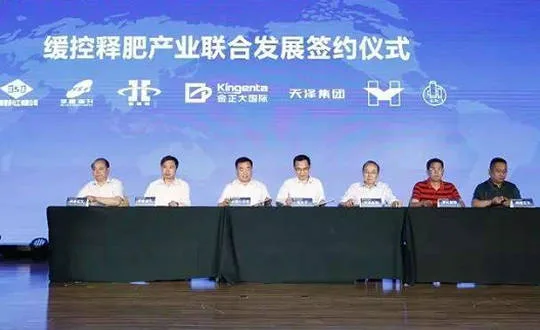
Industrial Technology Innovation Strategic Alliance for Slow/Controlled-Release Fertilizers

Industrial Technology Innovation Strategic Alliance for Slow/Controlled-Release Fertilizers

The Industrial Technology Innovation Strategic Alliance for Slow/Controlled-Release Fertilizers was founded under the lead of Kingenta Group and, after review and approval by the Ministry of Science and Technology, became one of the first 36 pilot alliances in China. It includes more than 20 member companies, universities and research institutions, all leaders in the R&D and industrialization of slow- and controlled-release fertilizers in China. Its establishment focuses on developing common and key industry technologies, strengthening the industry's capacity for independent innovation, solving technical bottlenecks and expanding the application and promotion of slow- and controlled-release fertilizers in China's agriculture. The alliance will also build an open, domestically and internationally leading platform for common technology R&D in the industry and an important vehicle for national support of enterprise technology innovation.

Industry-university-research collaboration

Kingenta Group has built long-term partnerships with more than 40 research institutions and universities in China and abroad. Through close industry-university-research collaboration, it turns fertilizer science and technology achievements and talent resources into real productivity.

Shandong Agricultural UniversityChina Agricultural UniversityNanjing Agricultural UniversityChinese Academy of Agricultural SciencesInstitute of Soil Science, Chinese Academy of Sciences (Nanjing)National Hybrid Rice Engineering Technology Research CenterNational Agro-Tech Extension and Service Center, Ministry of Agriculture and Rural AffairsCultivated Land Quality Monitoring and Protection Center, Ministry of Agriculture and Rural AffairsUniversity of Florida, USANorwegian University of Life SciencesHebrew University of Jerusalem, IsraelSouthern Institute of Agricultural Sciences, VietnamHawassa University, Ethiopia

2008.04

The company signed a cooperation agreement with the National Agro-Tech Extension and Service Center of the Ministry of Agriculture to jointly promote slow- and controlled-release fertilizers.

2008.05

Signed a science and technology cooperation agreement with the Institute of Soil Science, Chinese Academy of Sciences (Nanjing).

2008.05

Signed a science and technology cooperation agreement with the National Hybrid Rice Engineering Technology Research Center.

2010.06

The National Engineering Research Center for Slow/Controlled-Release Fertilizers signed a cooperation agreement with the University of Florida, USA.

2011.07

The National Engineering Research Center for Slow/Controlled-Release Fertilizers signed a research cooperation agreement with the National Engineering Research Center for Red Soil Improvement.

2012.12

Held a signing ceremony for industry-university collaborative innovation with Shandong Agricultural University, covering an academician research fund, the Kingenta scholarship and joint applications for national engineering (technology) research centers.

2014.07

Signed a strategic cooperation agreement with the Norwegian University of Life Sciences in Weng'an, Guizhou, building an international cooperation platform for agricultural technology innovation, microbial technology and new fertilizers.

2014.09

Signed a new round of strategic cooperation agreements with China Agricultural University, with in-depth cooperation in research, new fertilizer development and promotion, training of international talent and commercialization of results.

Expert team

Top researchers in new fertilizers, plant nutrition and phosphorus resource utilization provide solid talent and intellectual support for technology innovation.

Wan Lianbu

Researcher · Academic leader in new fertilizers

Director of the National Engineering Research Center for Slow/Controlled-Release Fertilizers, member of the National Technical Committee on Fertilizer and Soil Conditioner Standardization, executive council member of the Chinese Society of Plant Nutrition and Fertilizer Science, recipient of the State Council Special Allowance, and deputy to the 12th and 13th National People's Congress. He has led more than 20 provincial and ministerial projects and drafted 1 national standard and 3 industry standards; he holds 76 granted invention patents, 1 Second Prize of the National Science and Technology Progress Award and 1 First Prize of the Shandong Science and Technology Progress Award, among others, and has edited or co-edited more than 60 monographs.

Zhang Min

Professor · Doctoral supervisor

Deputy director of the National Engineering Research Center for Slow/Controlled-Release Fertilizers and doctoral supervisor at the College of Resources and Environment, Shandong Agricultural University. He has published more than 100 papers in journals such as Plant and Soil and J Plant Nutrition (over 20 SCI-indexed) and applied for 6 patents. He has led the national "948" technology introduction project, postdoctoral fund and innovation fund projects, and received 1 First Prize of the National Science and Technology Progress Award, 1 First Prize and 2 Second Prizes of the Shandong Science and Technology Progress Award.

Zhang Qiang

Senior agronomist · Ph.D.

Deputy director of the National Engineering Research Center for Efficient Utilization of Soil and Fertilizer and secretary-general of the National Slow/Controlled-Release Fertilizer Industry Technology Innovation Alliance. He has undertaken or participated in 15 provincial/ministerial or higher research projects, completed 23 technical evaluations/appraisals, holds 14 granted invention patents, has published 19 high-level papers and 3 monographs, and has received more than 10 provincial/ministerial or higher awards.

Zheng Shulin

Senior engineer

Deputy director of the National and Local Joint Engineering Research Center for Compound Fertilizers and member of the National Technical Committee on Fertilizer and Soil Conditioner Standards. Engaged in research on compound fertilizers and basic chemical raw materials, he has led 10 provincial/ministerial projects and participated in drafting 1 national standard and 1 industry standard. He holds 5 granted invention patents, 1 Second Prize of the National Patent Technology Invention Award and 1 Second Prize of the Shandong Science and Technology Progress Award.

Li Xinzhu

Ph.D. in Engineering · Engineer

Leads the comprehensive development of medium- and low-grade phosphate rock, completing R&D and industrialization of projects such as hydrochloric-acid-process phosphoric acid co-producing gypsum whiskers and fluoride salts, and phosphogypsum-to-sulfuric-acid with alkaline fertilizer co-production. He also took part in the development of water-soluble fertilizers, foliar fertilizers, microbial fertilizers and package fertilizers, holds 7 national invention patents with 6 more under examination, and has published more than ten papers.

Chen Jianqiu

Ph.D. in Plant Nutrition

Mainly engaged in the R&D and application of new fertilizers such as slow- and controlled-release and water-soluble fertilizers, and a core member of the Ministry of Science and Technology's key-area innovation team "Slow/Controlled-Release Fertilizer Technology Innovation Team". He took part in drafting multiple national and industry standards, holds more than 30 granted invention patents and has published 17 papers in core journals. He received the First Prize of the Shandong Science and Technology Progress Award in 2008 and the Second Prize of the National Science and Technology Progress Award in 2009, among others.

Song Tao

Ph.D. in Engineering

Mainly engaged in research, development and promotion of liquid fertilizers, foliar fertilizers and new functional fertilizers. He has taken part in projects under the National Science and Technology Support Program and the Shandong Major Independent Innovation Special Project, published more than ten papers and applied for multiple patents.

Yang Weihong

Ph.D.

Mainly engaged in research on phosphorus resource recycling and utilization of by-products of phosphate rock. He took part in developing key technologies such as monopotassium phosphate and wet-process phosphoric acid-based water-soluble industrial monoammonium phosphate (the monopotassium phosphate project reached an internationally advanced level) and in projects such as comprehensive utilization of phosphate rock by nitric acid decomposition. He has published 9 papers and applied for 9 patents, 5 of which have been granted.

Yang Li

Researcher

Mainly engaged in soil improvement, plant nutrition and fertilization, and development of new fertilizers. He has led 3 provincial projects and participated in 2 national and 2 provincial projects, and received 3 Second Prizes of the provincial Science and Technology Progress Award and 1 Third Prize of the Ministry of Agriculture's Science and Technology Progress Award. He has published more than 50 papers and edited the three-volume, 37-book Crop Nutrition and Fertilization series. He is currently the company's technical director for agrochemical service projects.

Li Junliang

Professor · Doctoral supervisor

Deputy director of the Shandong Engineering Research Center for Integrated Water and Fertilizer Management, professor at Qingdao Agricultural University and vice dean of its College of Resources and Environment. He has led or taken part in 44 research projects, published more than 80 academic papers, and edited textbook series such as New Techniques for Irrigation and Fertilization of Vegetables and Soil-Testing and Formula Fertilization for Vegetable Gardens.

Chen Qing

Professor

Professor at China Agricultural University, who takes part in Kingenta's industry-university-research cooperation and technical research.

Kevin Moran

Dr. Kevin MoranGroup technical advisor

Former Chief Technology Officer of Yara in Norway, with more than 30 years of experience in the development, production and marketing of new fertilizers such as slow- and controlled-release and nitrate-based fertilizers, and widely known and influential in the international fertilizer industry. He was appointed technical advisor to Kingenta Group in July 2014.

Robert Rennie

Dr. Robert RennieSpecial advisor for biotechnology R&D and application

Former executive at two listed companies in Canada, Agrium and Sparr Resources, with years of experience in successful new-product development and more than thirty years of experience in R&D and industrialization of slow- and controlled-release, nitrate-based and biological fertilizers. He was appointed special advisor for biotechnology R&D and application to Kingenta Group in July 2014.

Innovation achievements

Innovation drives technological progress. Kingenta has undertaken 78 major national and provincial research projects, led the formulation of 28 industry, national and international standards, holds 291 invention patents, and has won numerous national and provincial/ministerial science and technology awards.
3National science and technology awards
28Industry, national and international standards
78+Major national and provincial research projects
291Invention patents

Through its technology-leading strategy, Kingenta has made new progress in new slow- and controlled-release fertilizers, water-soluble fertilizers, biological fertilizers, package fertilizers, foliar fertilizers, alkaline fertilizers, nitrate-based compound fertilizers, comprehensive use of medium- and low-grade phosphate rock and related phosphorus chemical technologies.

National award

2 Second Prizes of the National Science and Technology Progress Award

Major achievements in new fertilizers and efficient nutrient use.

National award

1 National Technology Invention Award

Core technology inventions recognized nationally.

Intellectual property

4 China Patent Excellence Awards

High-value patents recognized by the industry.

Intellectual property

3 First Prizes of the Shandong Patent Award

Leading high-value patents in the region.

Brand

2 China Well-Known Trademarks

Brand value protected at the national level.

Standards

28 standards led

Took part in drafting 25 industry, national and international standards.

Science and technology awards

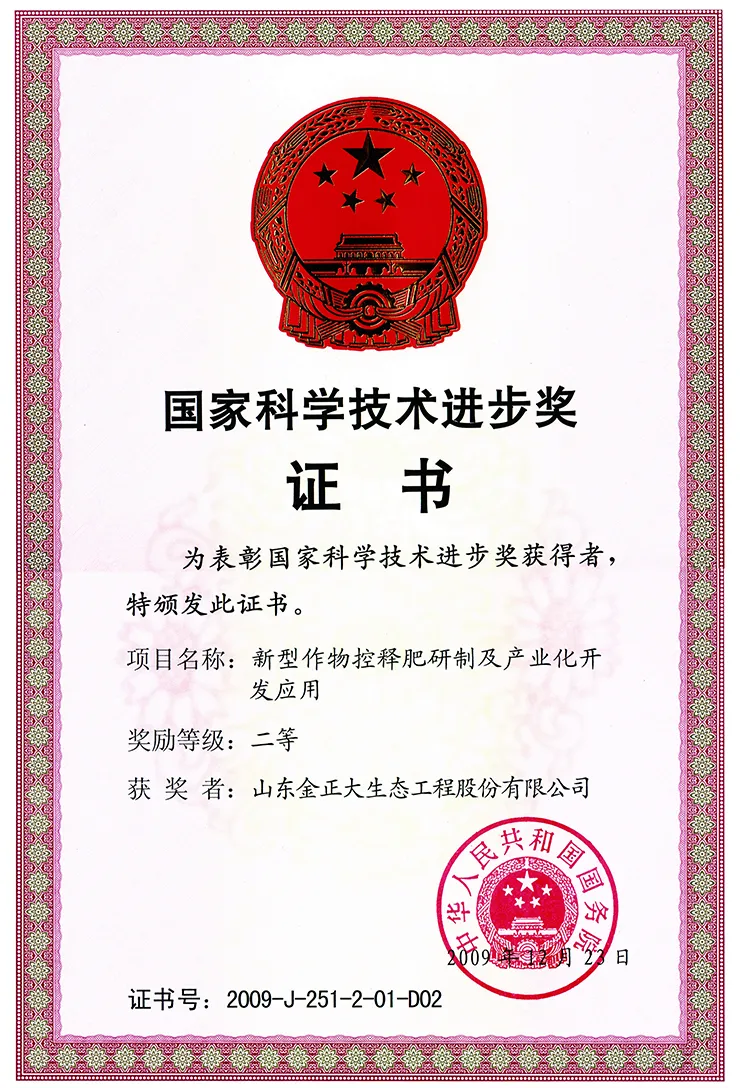
Second Prize of the National Science and Technology Progress Award: R&D and industrial application of new controlled-release crop fertilizers
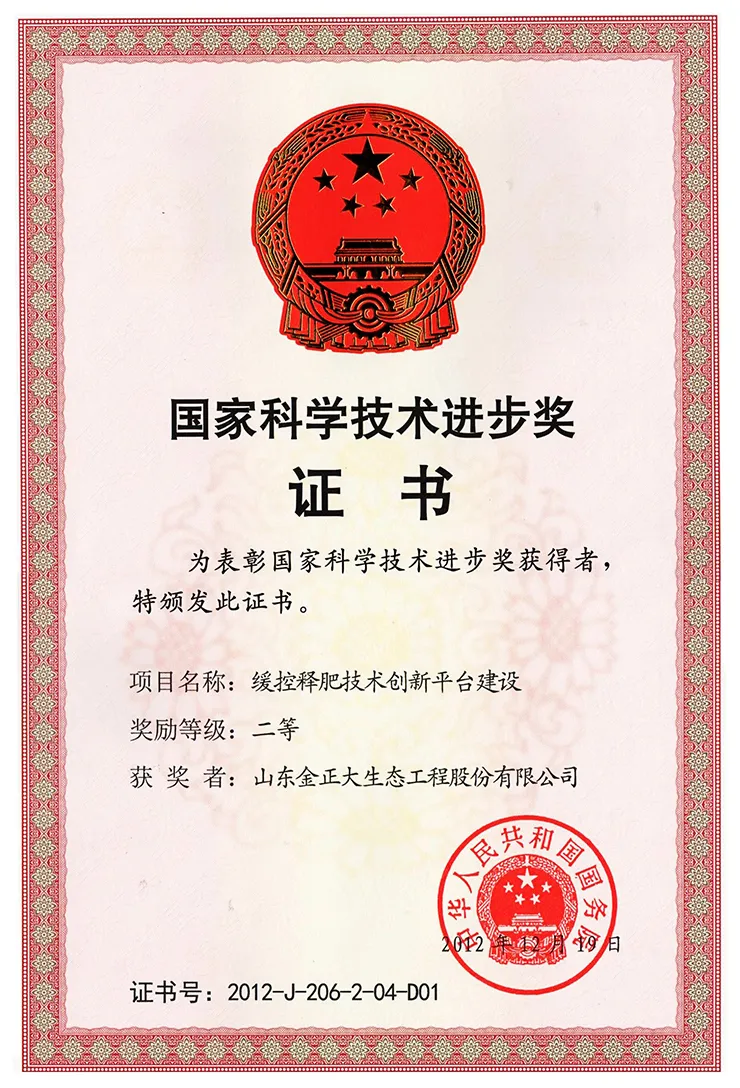
Second Prize of the National Science and Technology Progress Award: building a technology innovation platform for slow- and controlled-release fertilizers
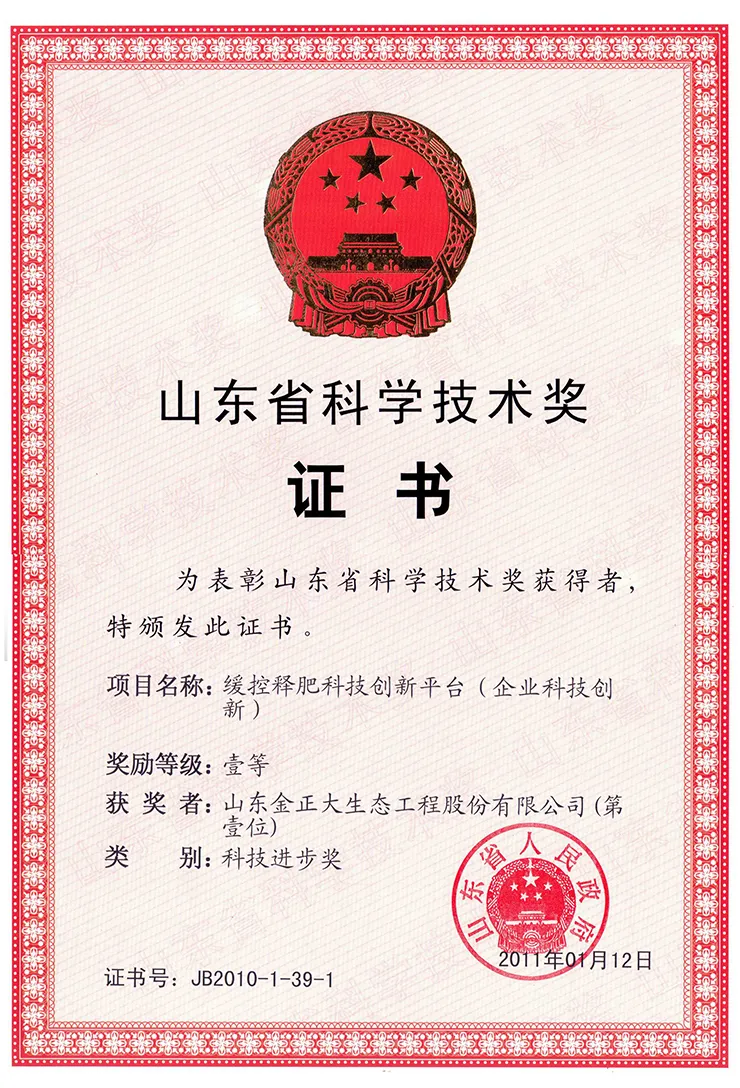
2011 First Prize, Shandong Science and Technology Progress Award
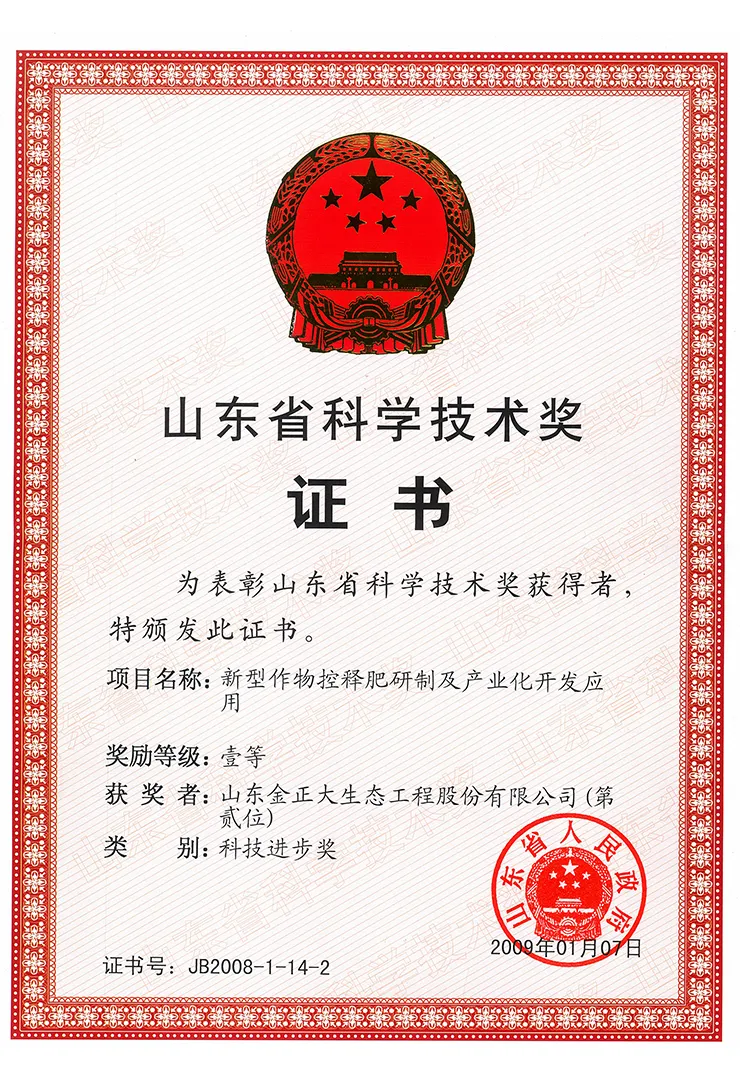
2009 First Prize, Shandong Science and Technology Progress Award
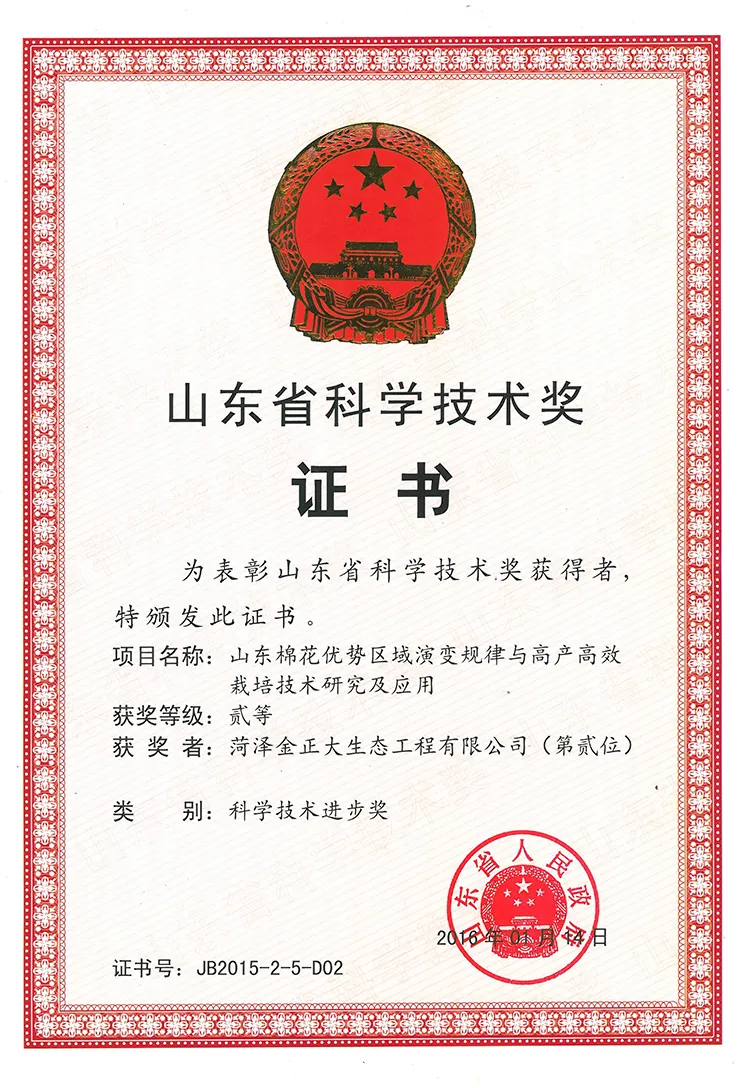
2016 Second Prize, Shandong Science and Technology Award: evolution of Shandong's cotton advantage zones and research and application of high-yield, high-efficiency cultivation (Heze Kingenta)
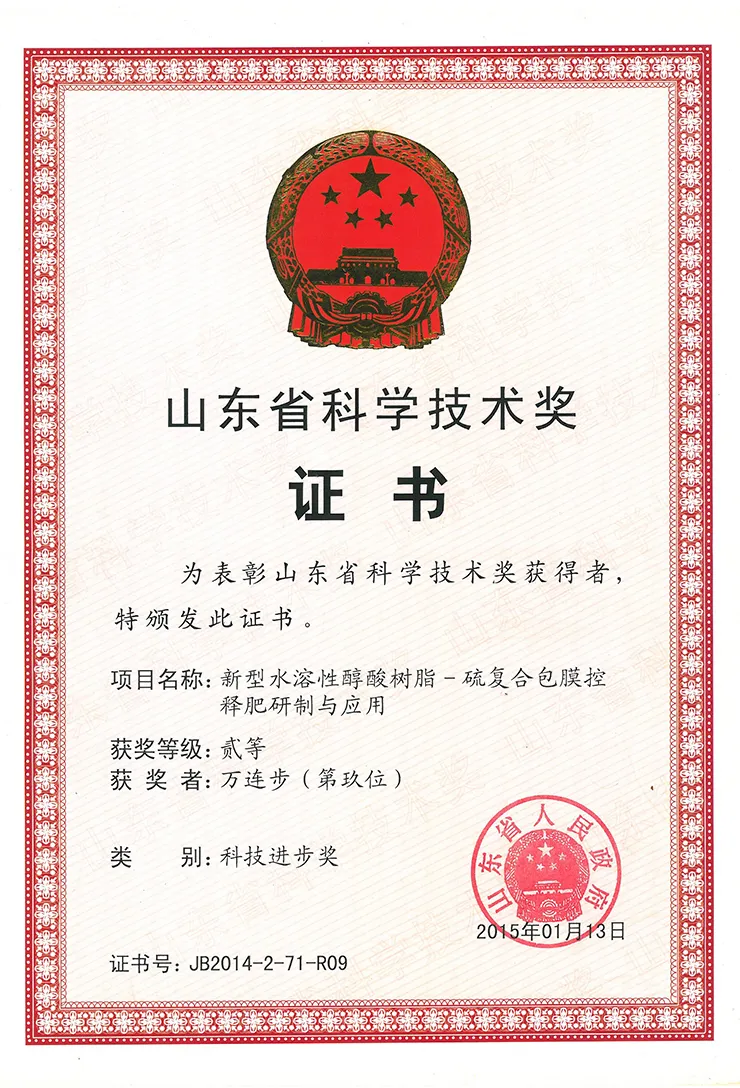
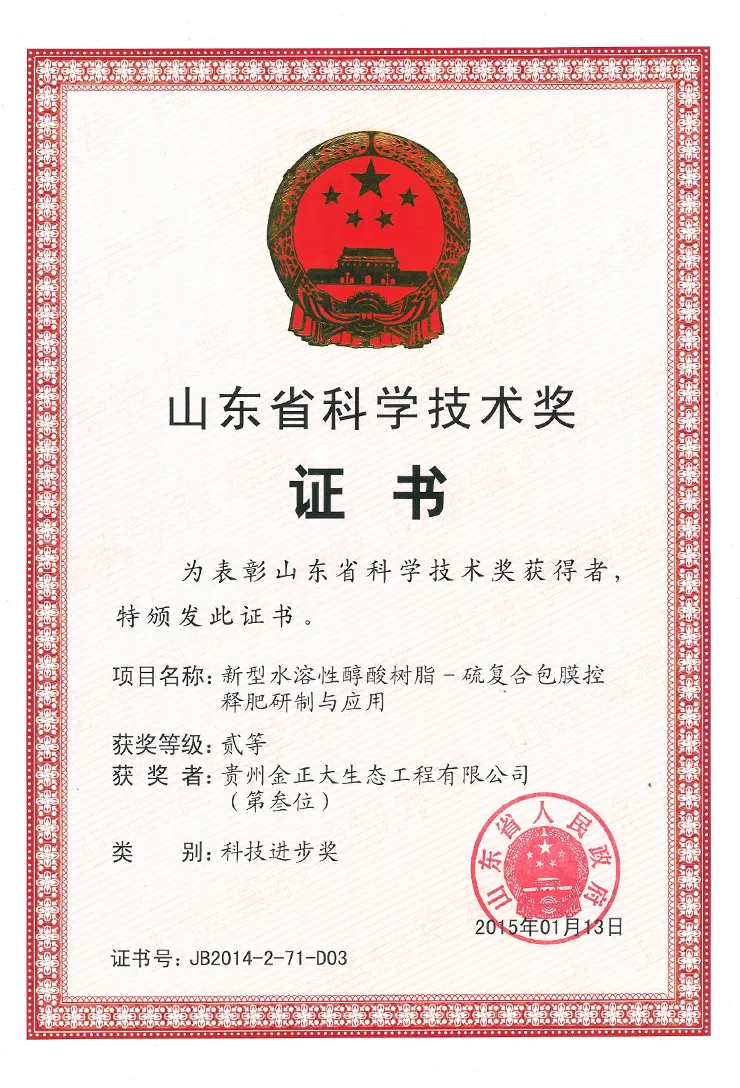
2015 Second Prize, Shandong Science and Technology Award: development and application of new water-soluble alkyd resin–sulfur composite coated controlled-release fertilizer (Wan Lianbu)
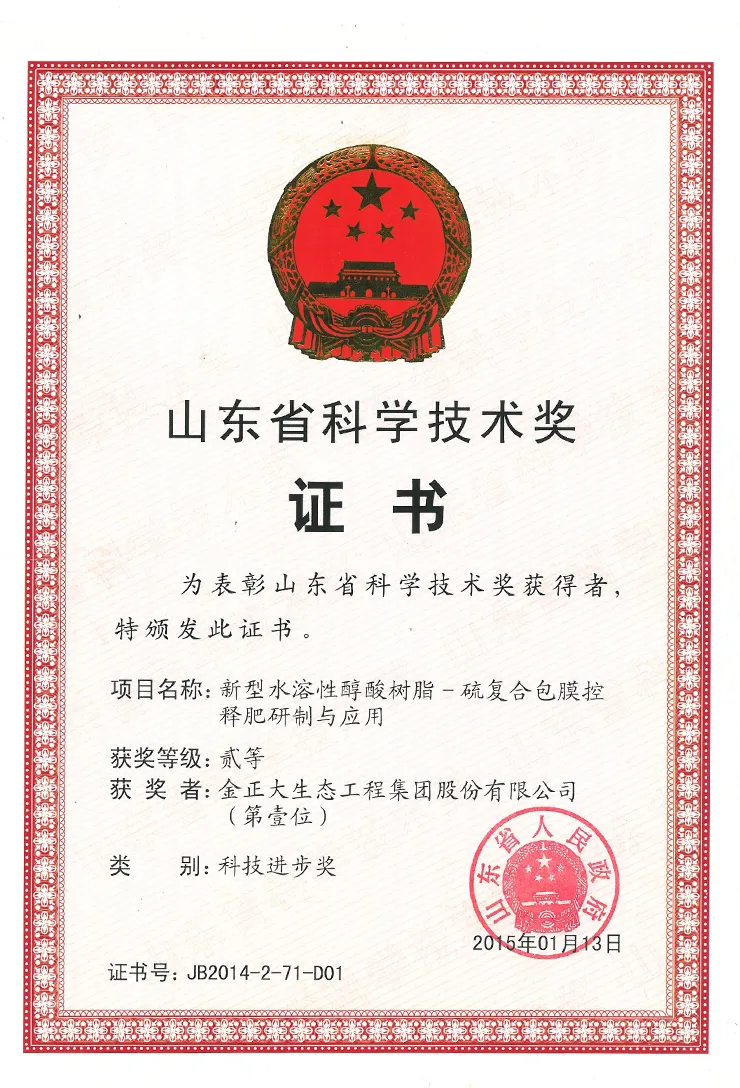
2015 Second Prize, Shandong Science and Technology Award: development and application of new water-soluble alkyd resin–sulfur composite coated controlled-release fertilizer (Kingenta Group)
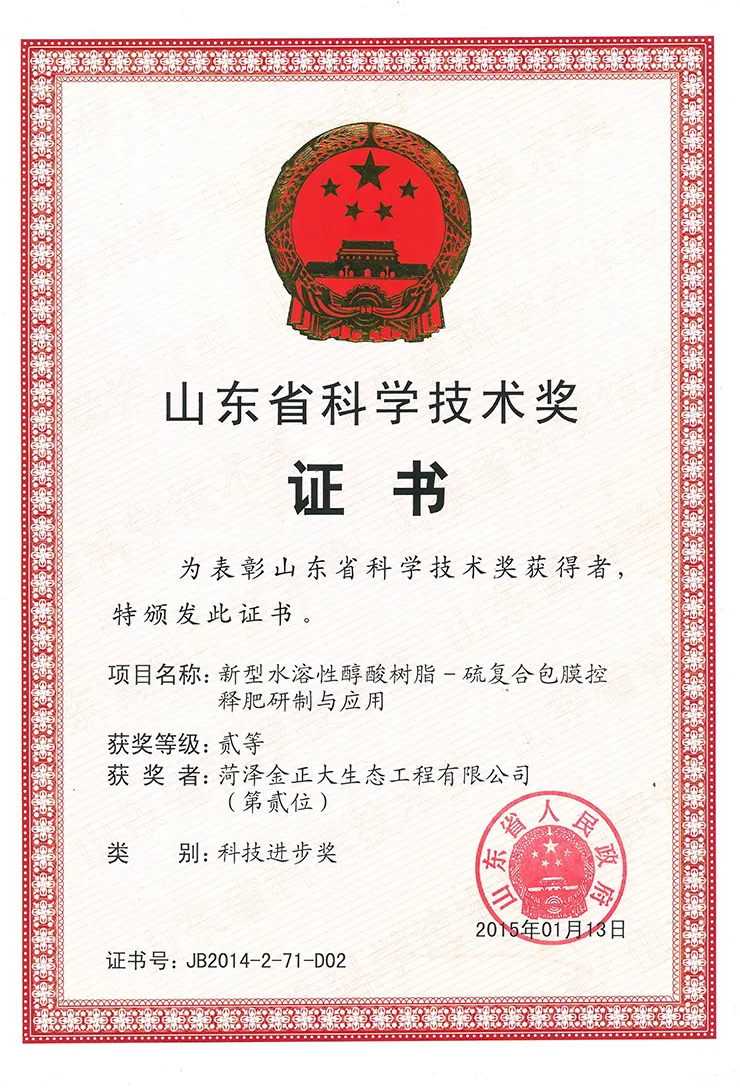
2015 Second Prize, Shandong Science and Technology Award: development and application of new water-soluble alkyd resin–sulfur composite coated controlled-release fertilizer (Heze Kingenta)
2015 Second Prize, Shandong Science and Technology Award: development and application of new water-soluble alkyd resin–sulfur composite coated controlled-release fertilizer (Guizhou Kingenta)
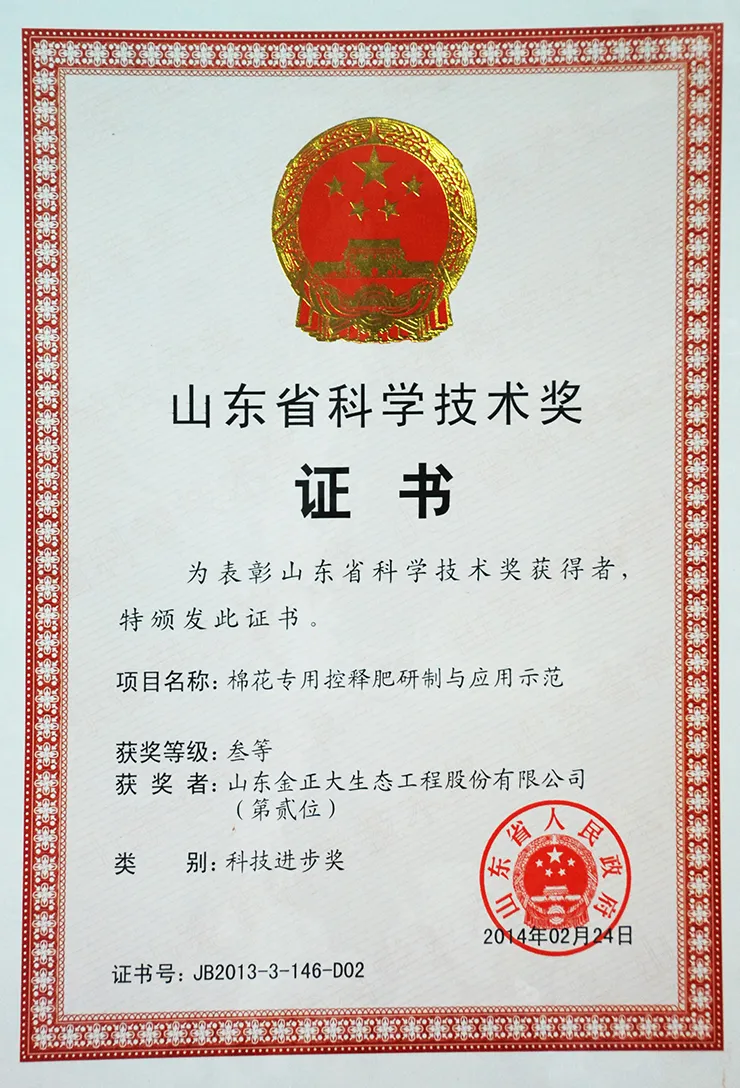
2014 Third Prize, Shandong Science and Technology Progress Award: development and demonstration of controlled-release fertilizer for cotton
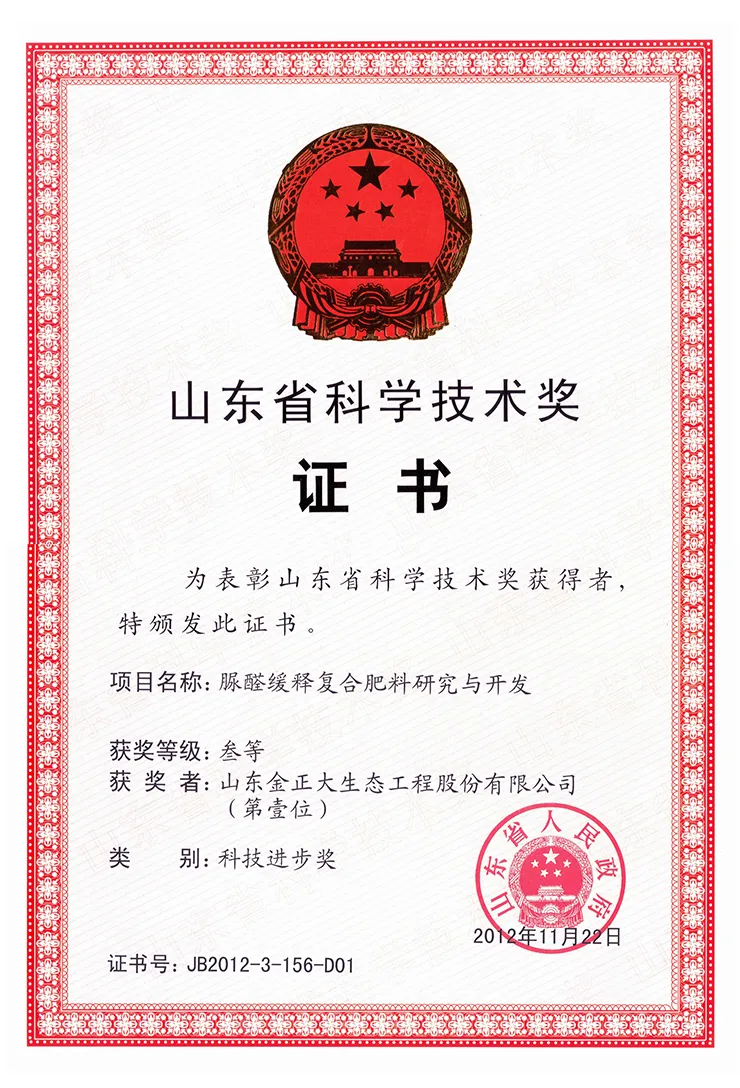
2012 Third Prize, Shandong Science and Technology Progress Award: urea-formaldehyde (Shandong Kingenta)
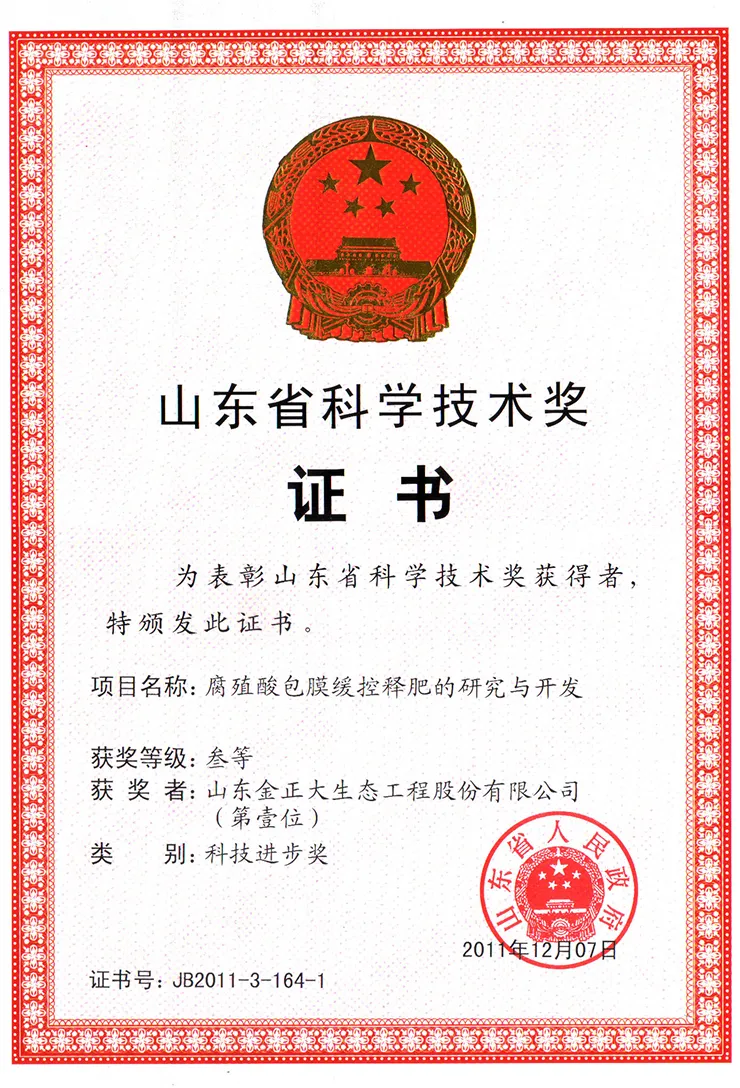
2011 Third Prize, Shandong Science and Technology Progress Award: humic acid

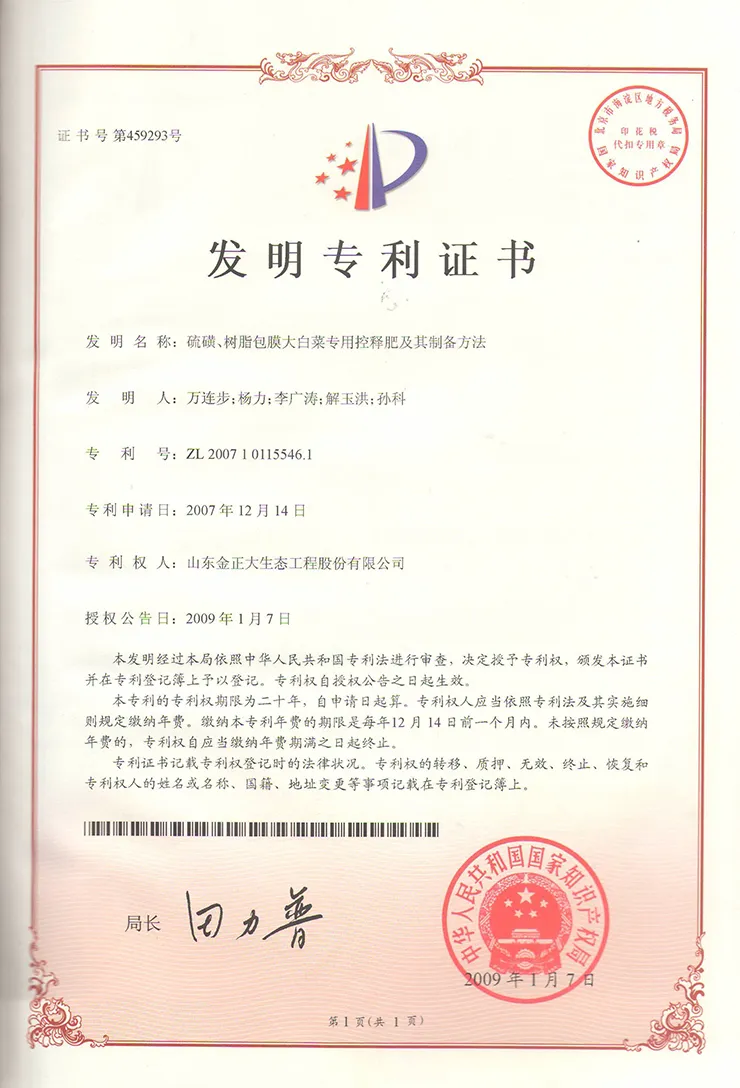
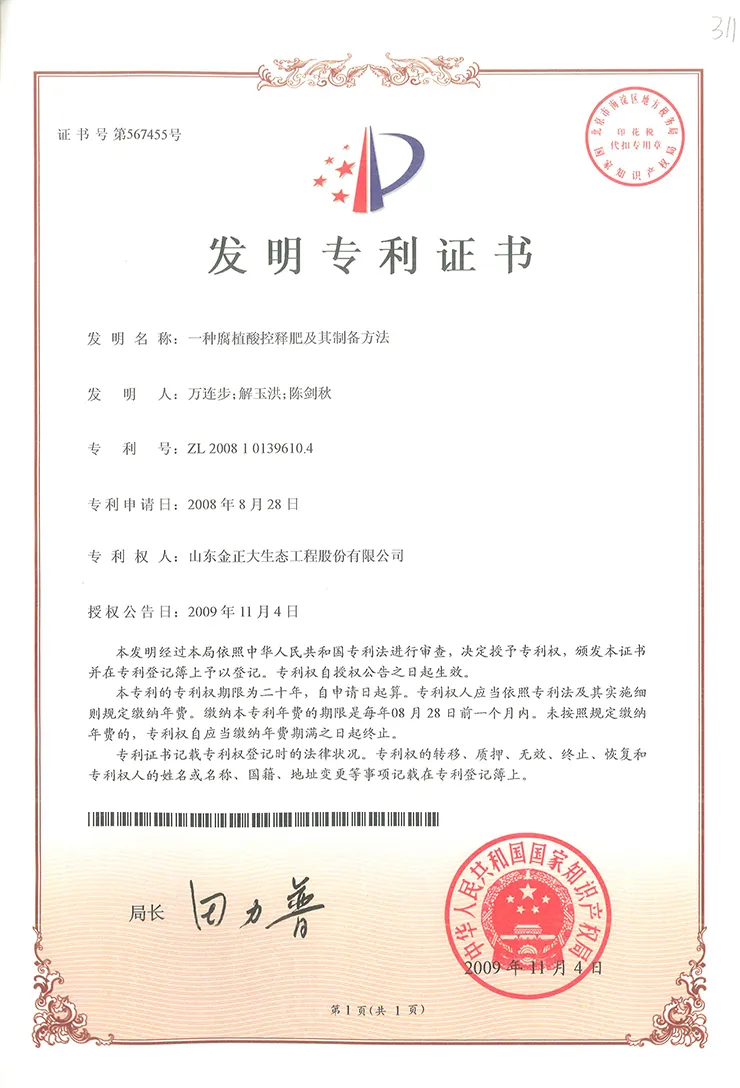
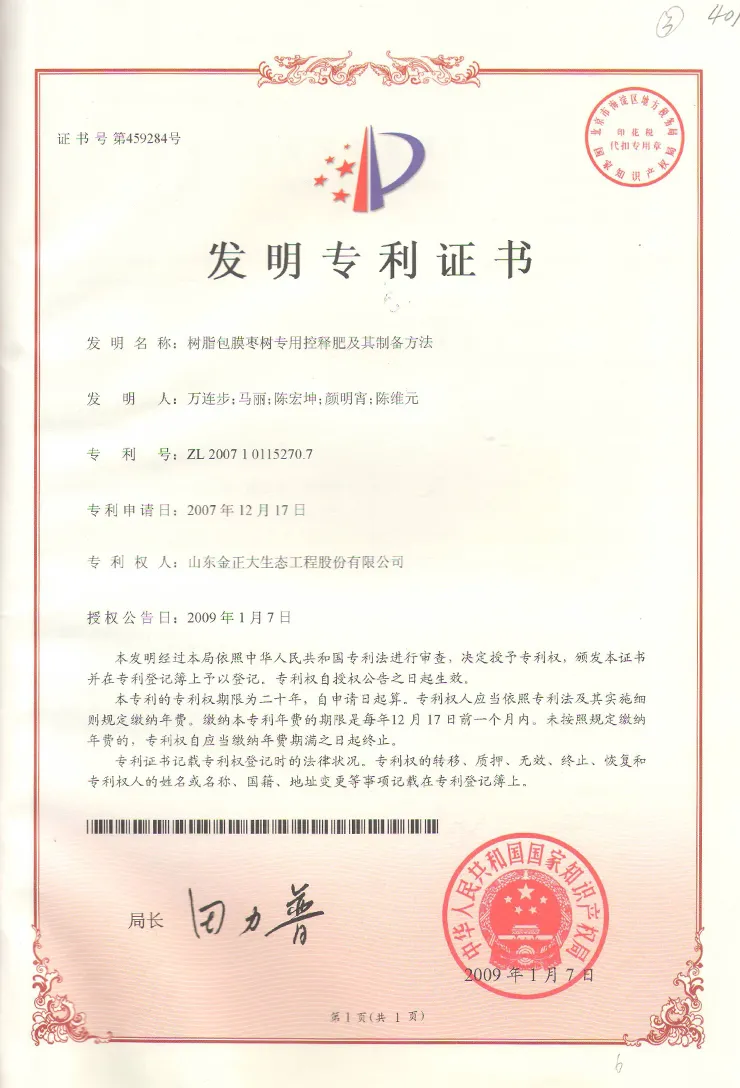
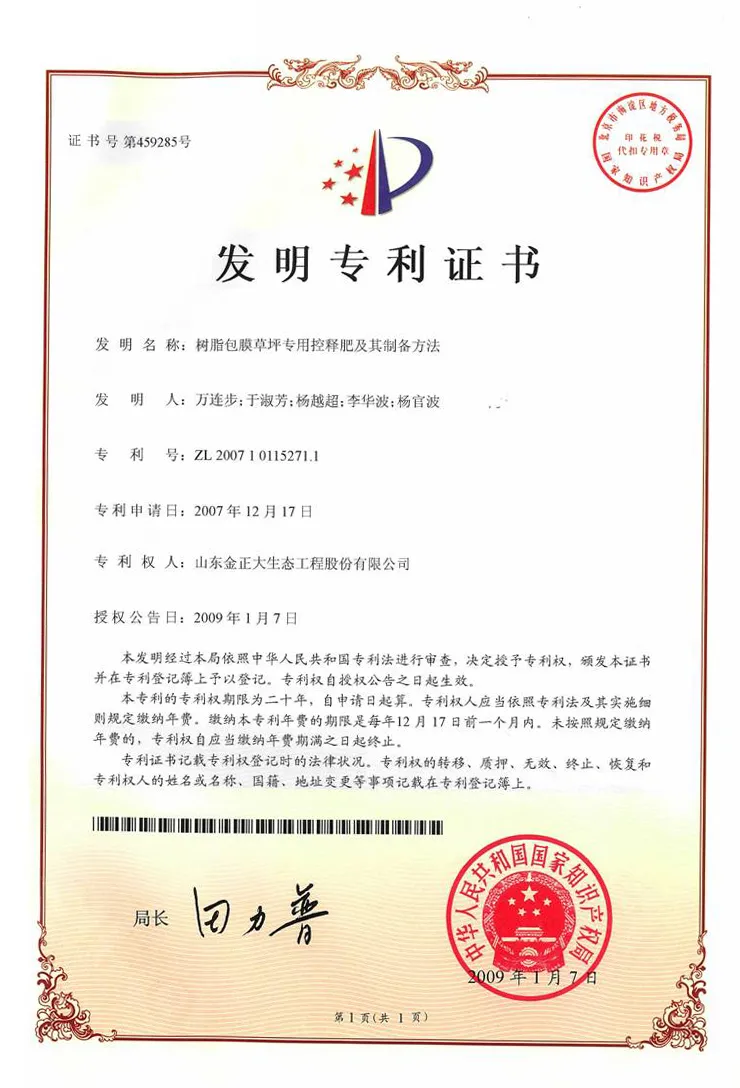
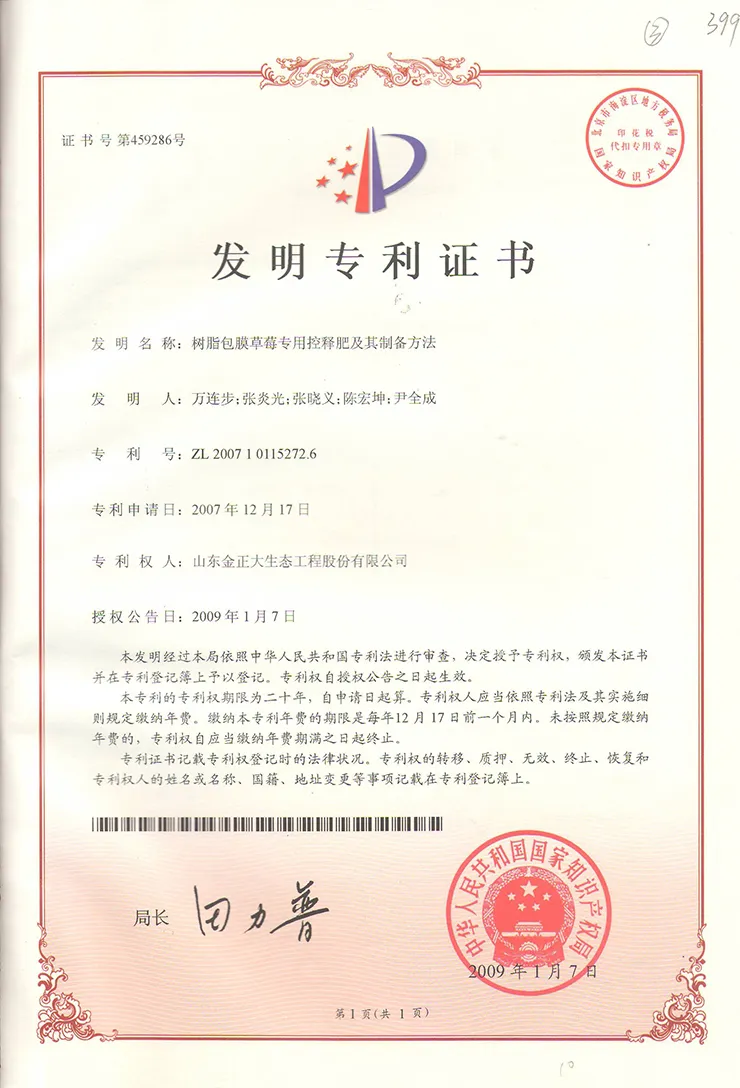
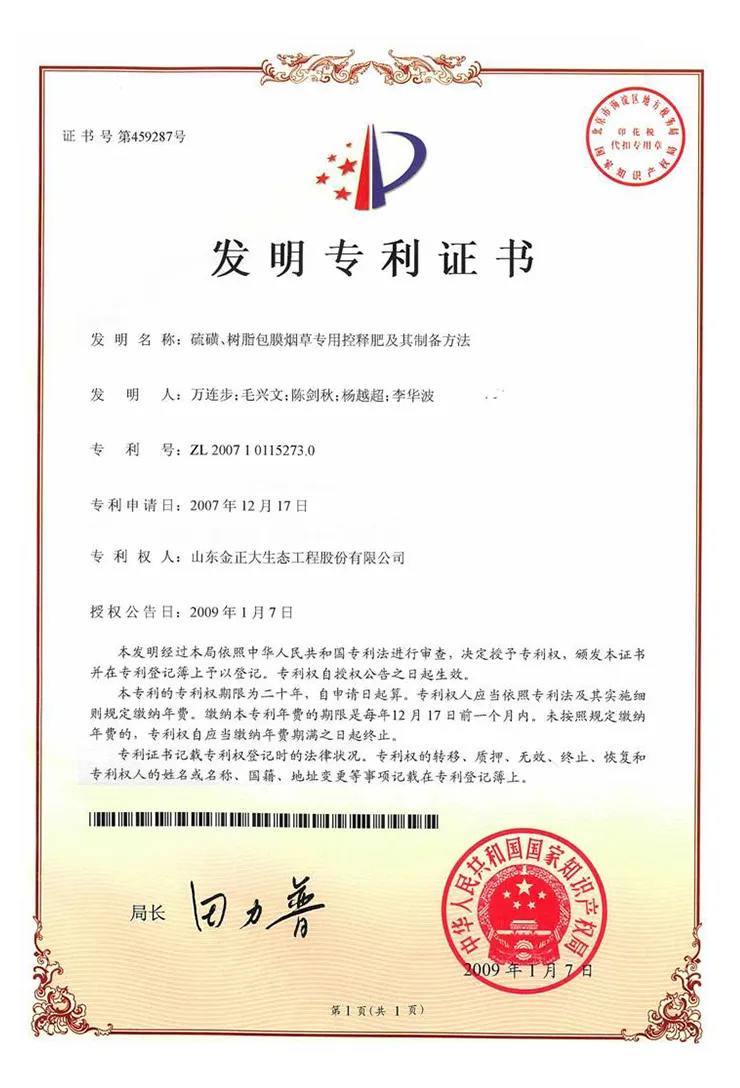
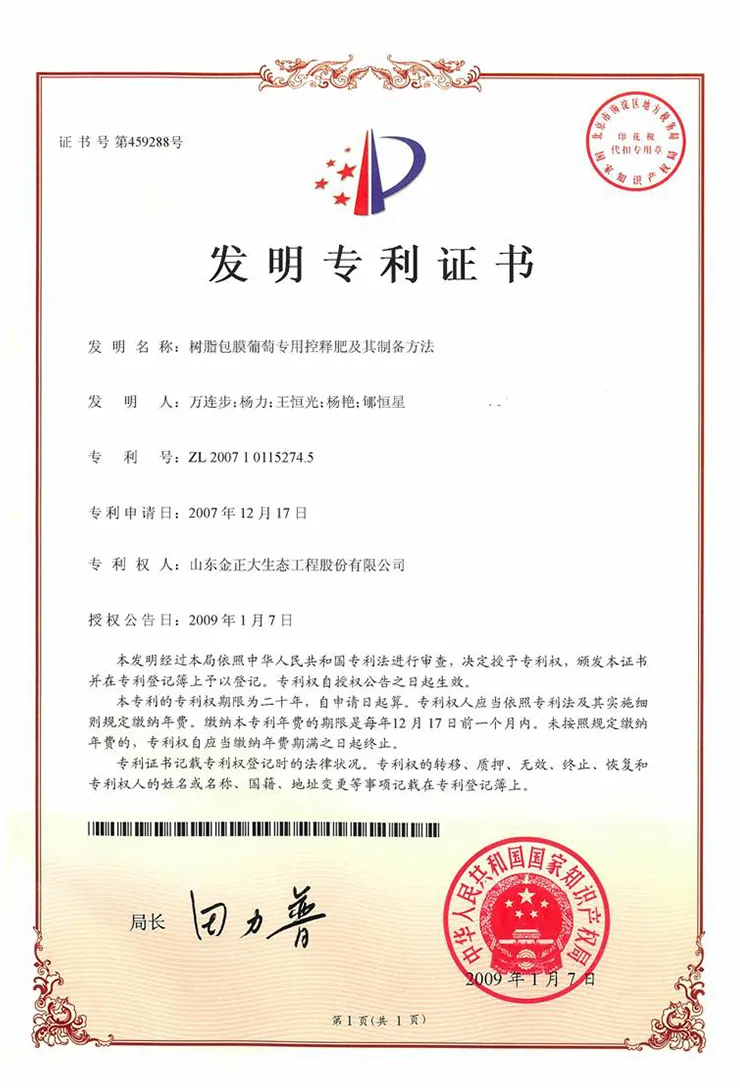
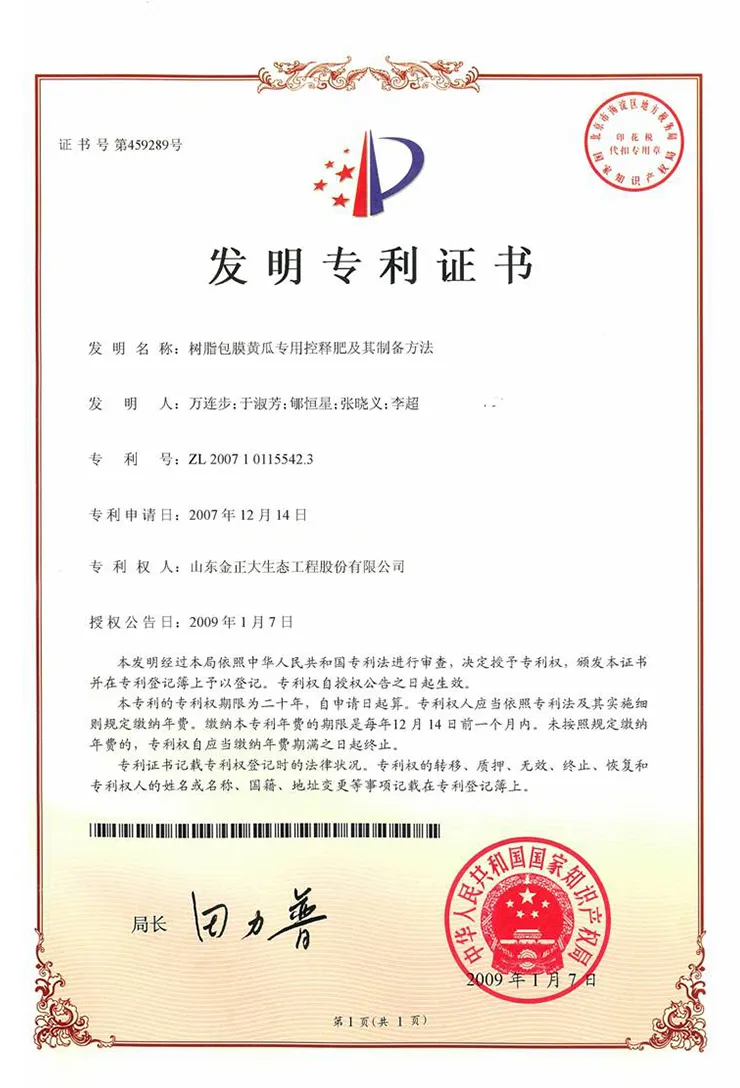
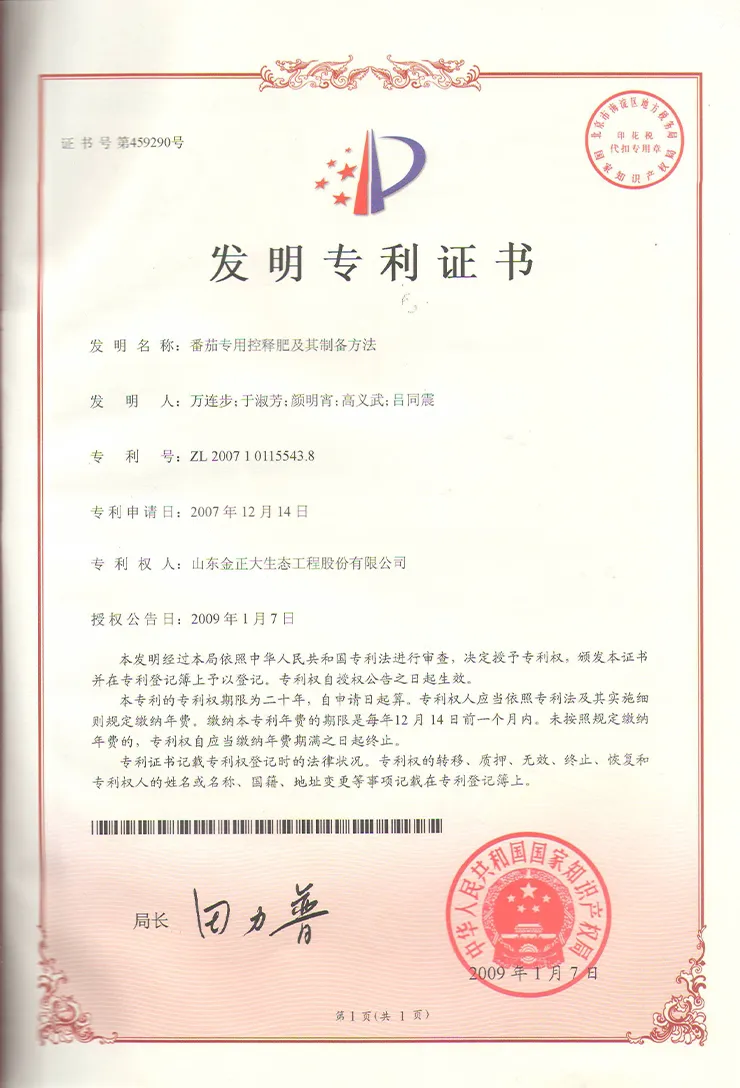
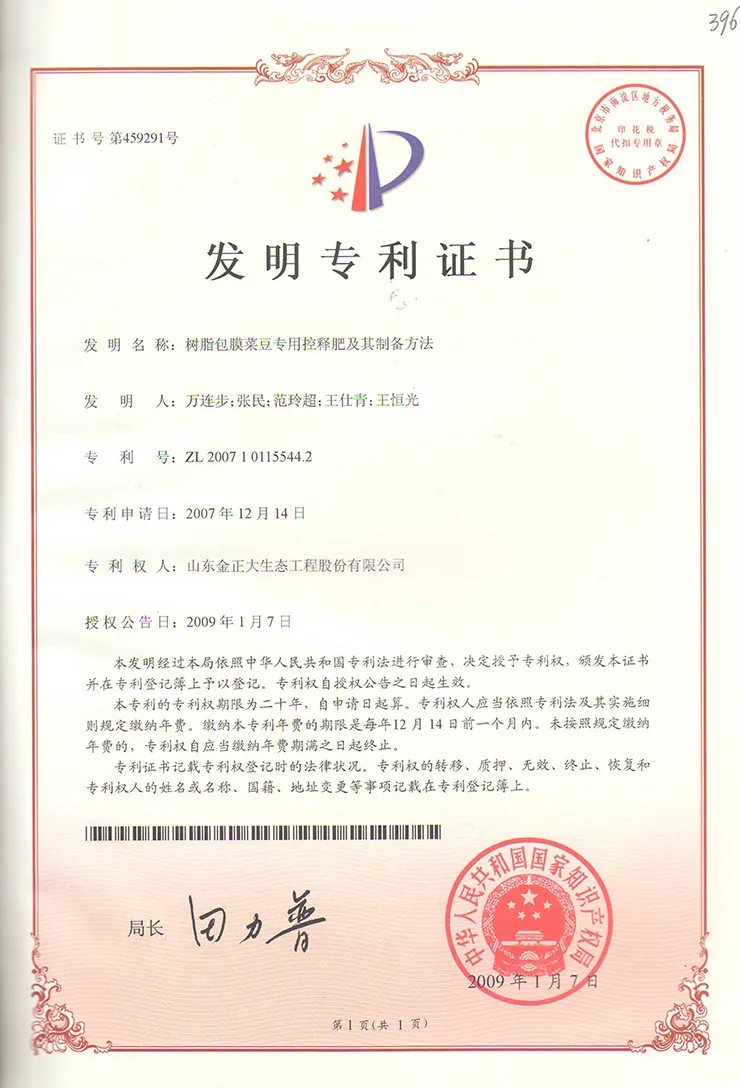
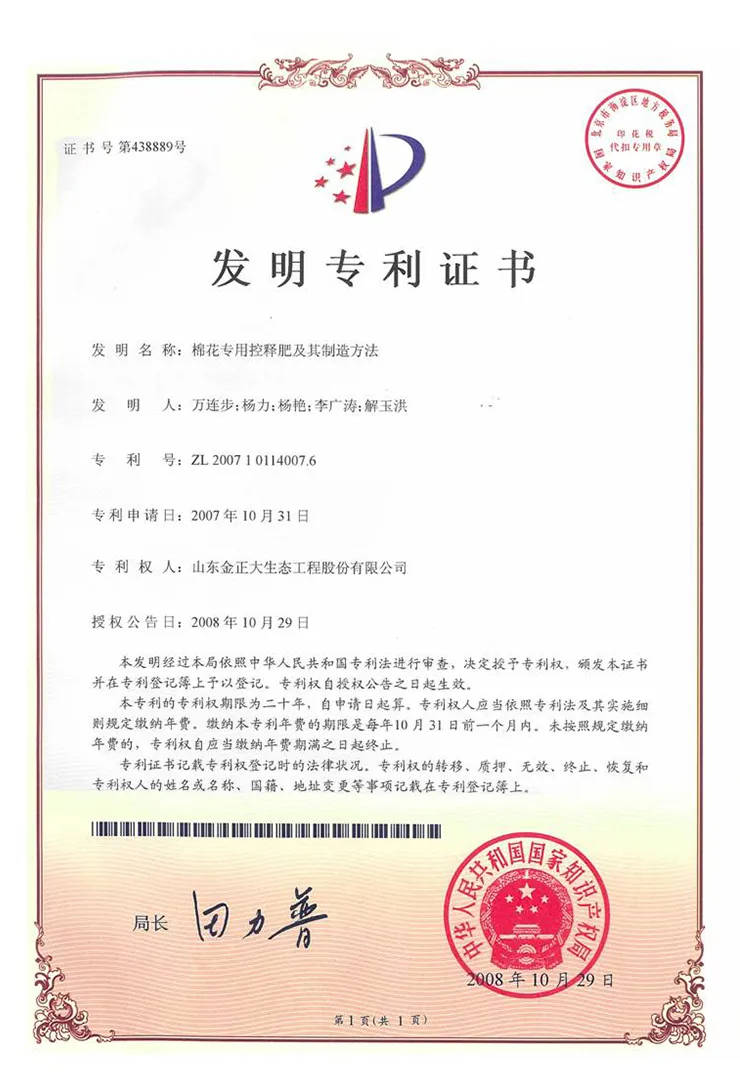
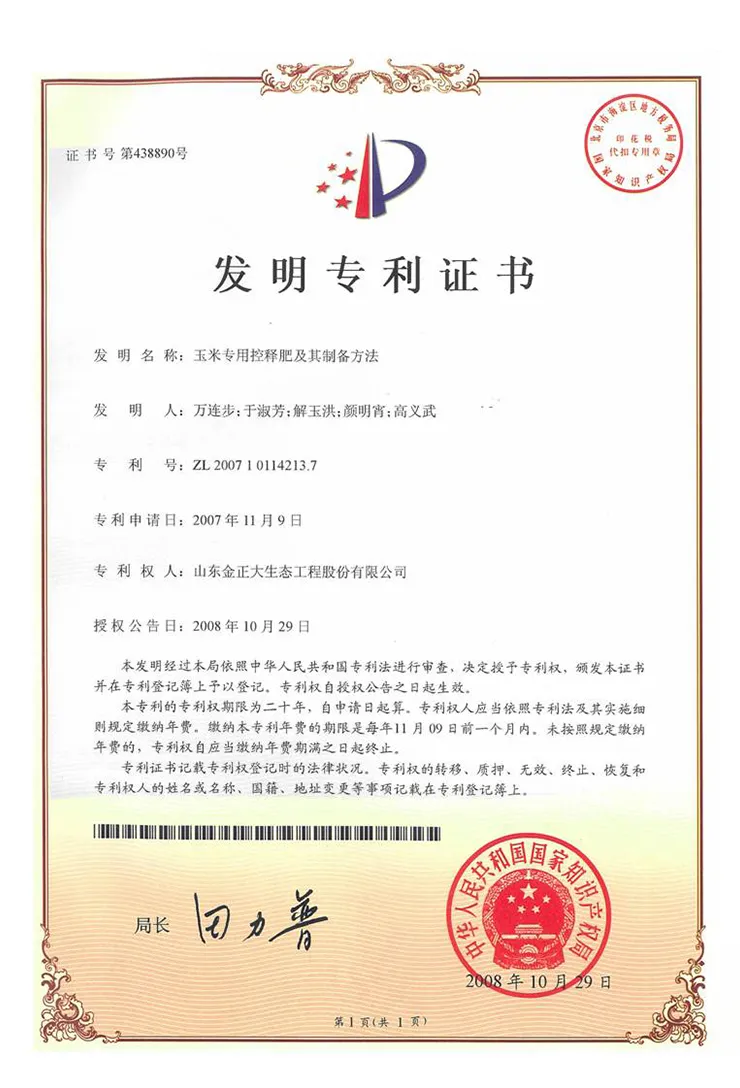
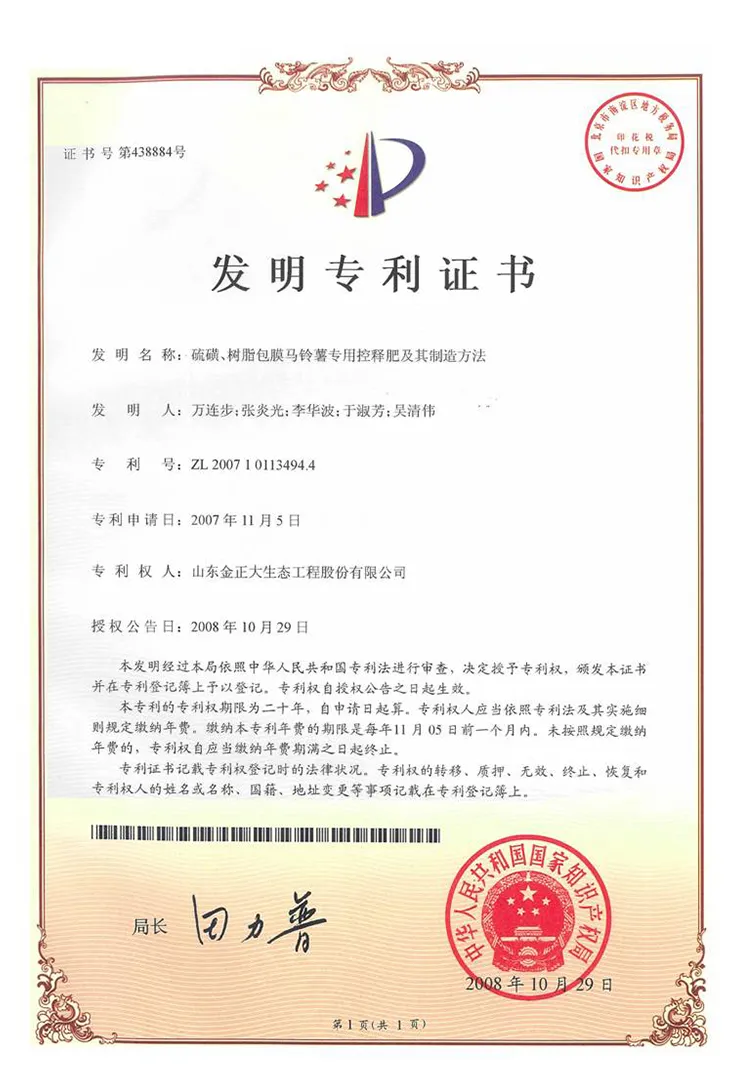
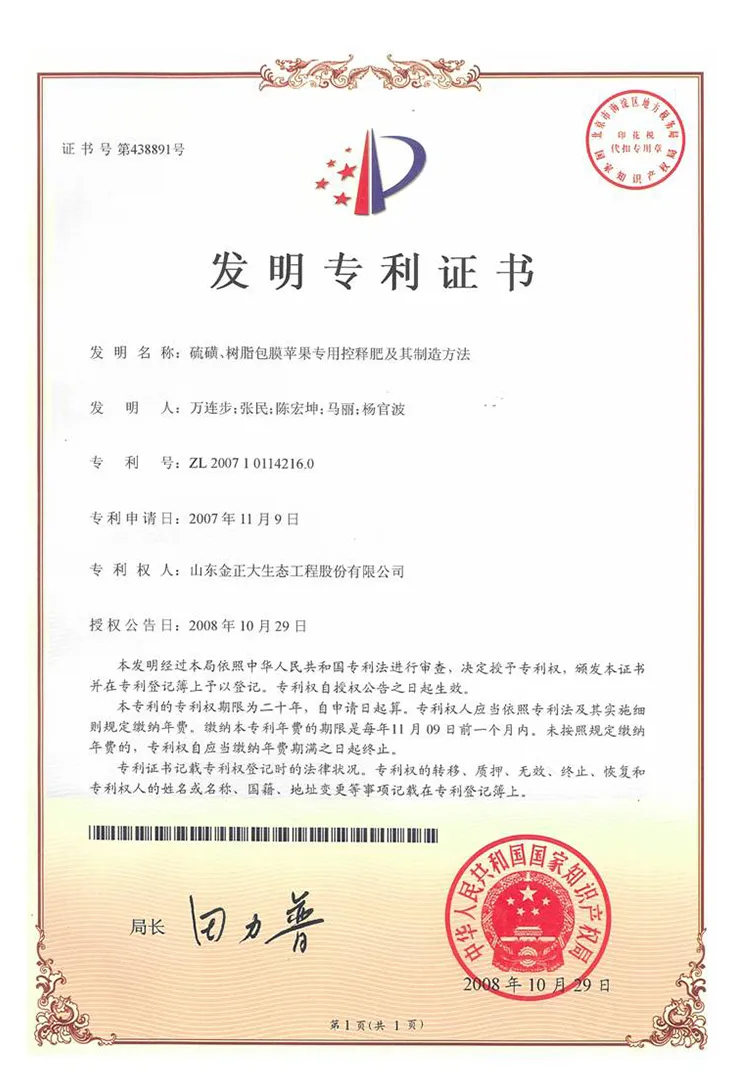
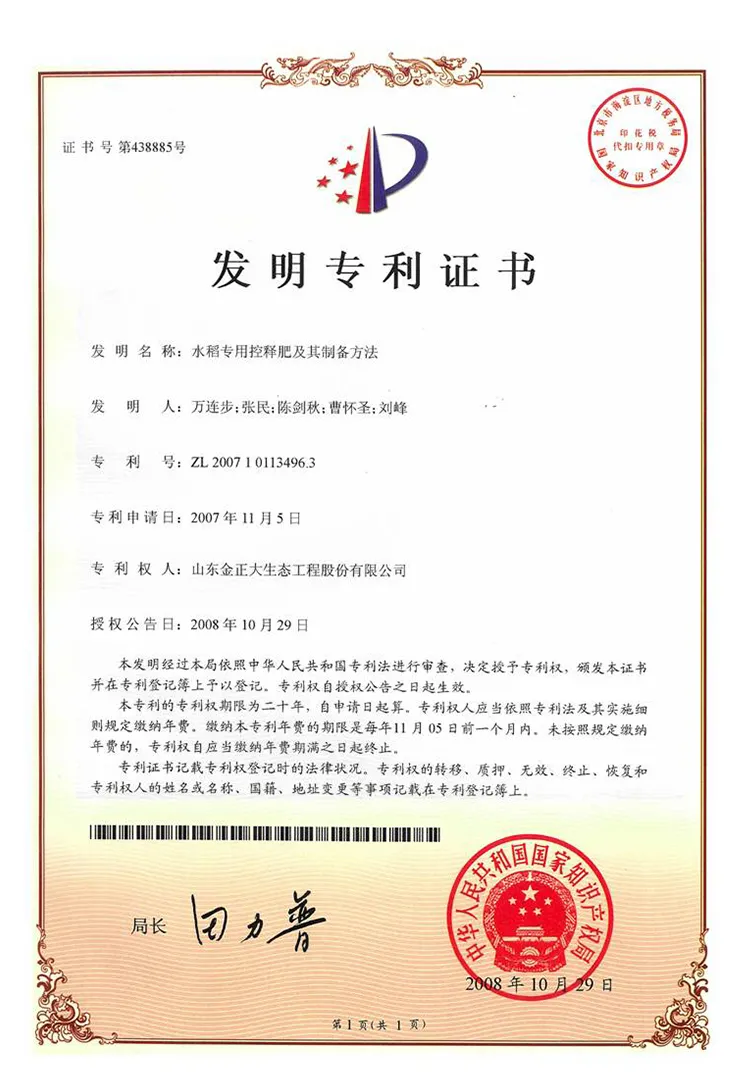
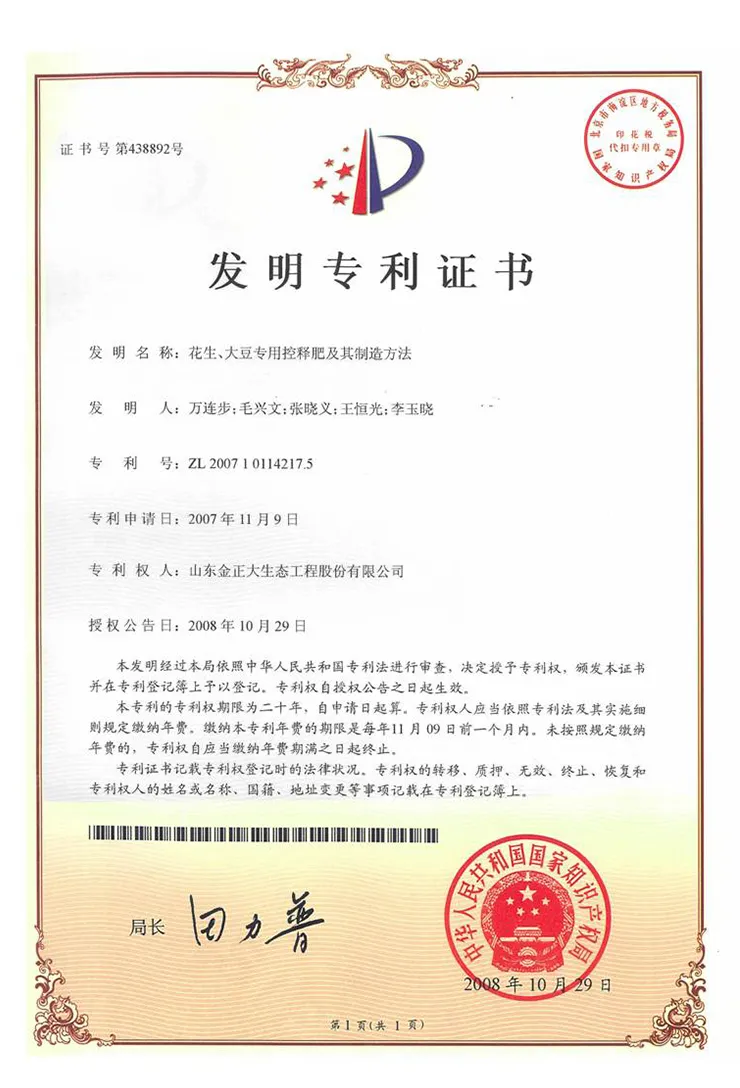
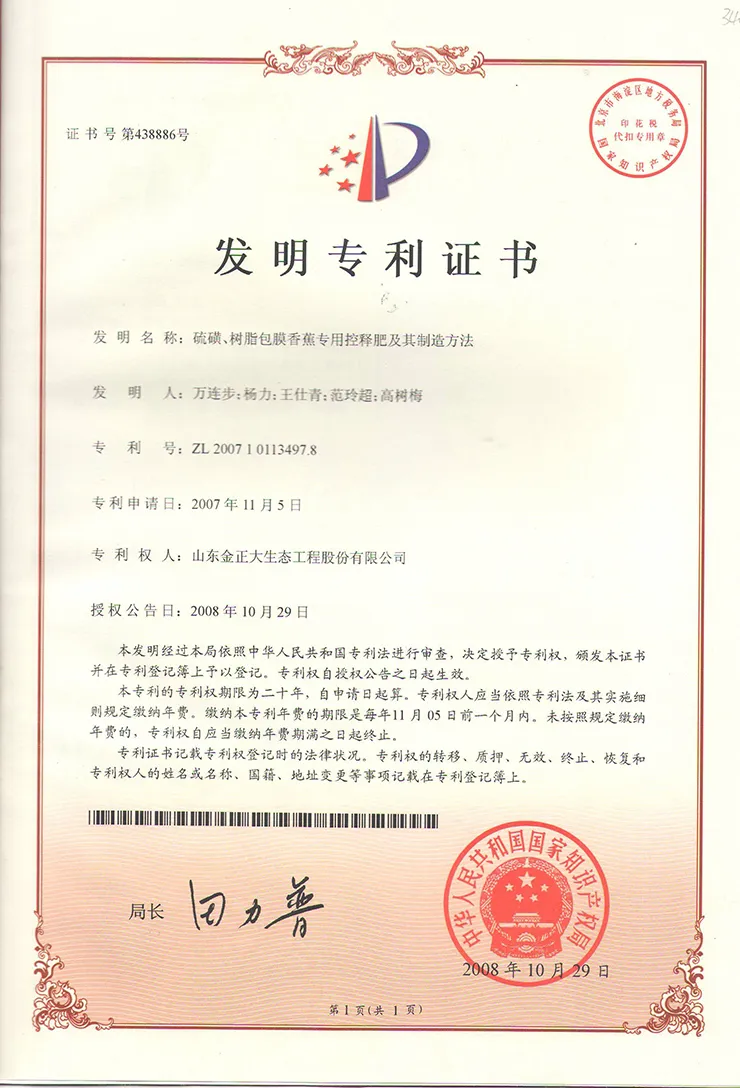
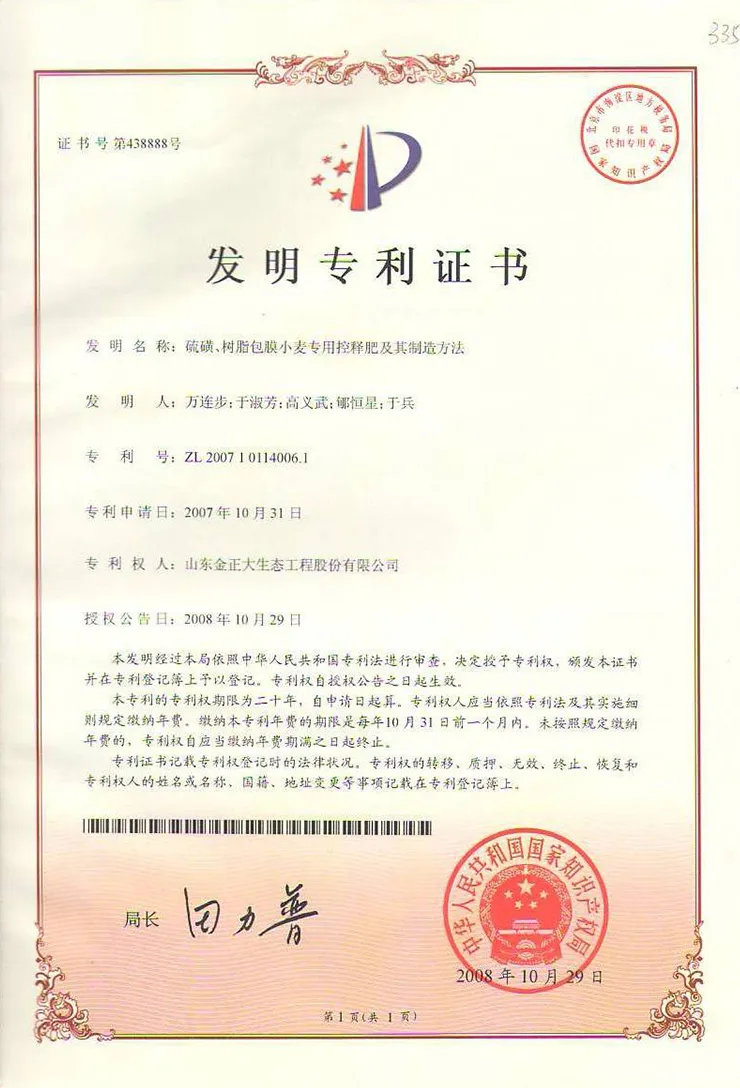
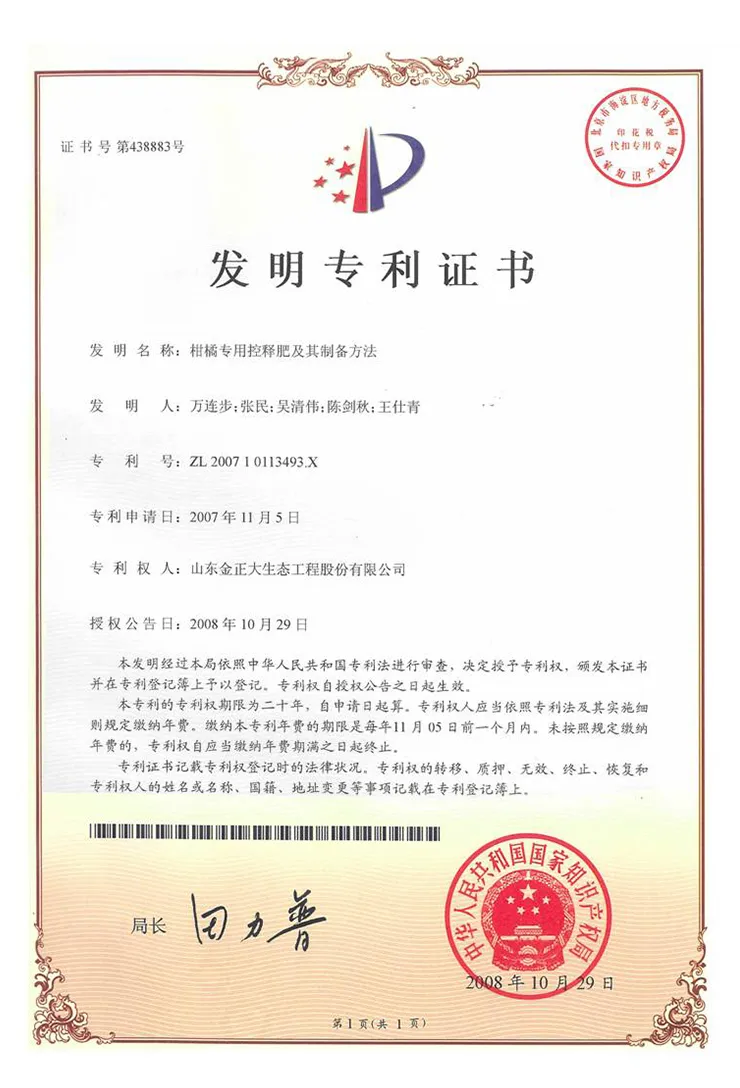
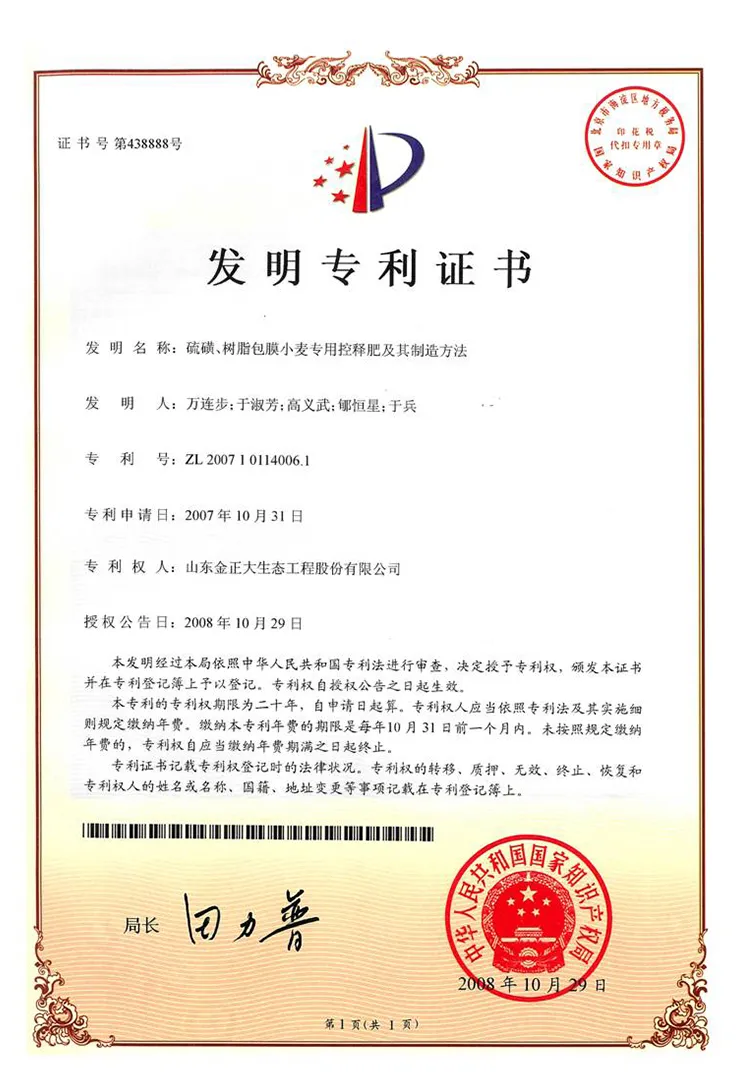
Patent certificates

2009 patent certificate
2008 patent certificate

Standard setting

Some of the industry, national and international standards that Kingenta helped draft and that have been issued and implemented are listed below:

No.Standard nameStandard typeStandard numberEffective dateCurrently in force
1Slow- and controlled-release fertilizersIndustry standardHG/T 3931-20072007.10.01Yes
2Slow-release fertilizersNational standardGB/T 23348-20092009.09.01Yes
3Special fertilizers and soil conditioners for golf-course turfIndustry standardHG/T 4136-20102011.03.01Yes
4Controlled-release fertilizersIndustry standardHG/T 4215-20112012.07.01Yes
5Calcium nitrate for agricultural useIndustry standardHG/T 4580-20132014.03.01Yes
6Nitrate-based compound fertilizersIndustry standardHG/T 4851-20162016.07.01Yes
7Classification of fertilizers and soil conditionersNational standardGB/T 6274-20162017.03.01Yes
8Classification of fertilizers and soil conditionersNational standardGB/T 32741-20162017.03.01Yes
9Controlled-release fertilizersNational standard (international)ISO 18644:20162016.04Yes

Comprehensive resource utilization

Around the green phosphorus-chemical cycle, Kingenta has made key breakthroughs in beneficiation tailings, phosphogypsum and fluorine recovery:

Beneficiation tailings utilization

In cooperation with Tsinghua University, Kingenta has developed a technology that uses beneficiation residue as the main raw material to make soil conditioners for improving acidified soil and supplementing calcium, magnesium and other trace elements. An industrial pilot plant will be built in Weng'an, where phosphate beneficiation residue can be fully consumed for comprehensive resource utilization.

Phosphogypsum resource utilization

Phosphogypsum is used as a raw material to produce sulfuric acid, which is then used to decompose phosphate rock, recycling sulfur resources; the residue is used to make cement or alkaline fertilizer, making comprehensive use of calcium, magnesium and other resources. China generates about 50 million tonnes of phosphogypsum a year, and this technology explores a solution for its resource utilization.

Fluorine recovery and utilization

Fluorine-containing exhaust gas from wet-process phosphoric acid is purified and combined with the fluorine recovery system of wet-process phosphoric acid to produce raw material for fluoride salts, offering a new approach to China's increasingly scarce fluorine resources; the tail gas is discharged up to standard, delivering both environmental and economic benefits.

Grow with Kingenta Let's build a sustainable future together

Whether you need bulk commodity supply, custom OEM formulation, or regional distribution partnership, Kingenta delivers global scale with tailored regional service.