
Controlled-release fertilizers are granules with a coating that limits how fast the nutrient dissolves and leaves the granule. The coating does not stop nutrients entering the soil, and it does not change the total amount of nutrient that the crop can eventually take up. What it does is set the pace, so that nutrient supply is closer to what the crop takes up across the season, rather than arriving in a large pulse after application.
This matters because a conventional soluble fertilizer delivers most of its nutrient in the first days or weeks. Much of it is lost before the crop has the root system or the leaf area to use it, through leaching, volatilization or fixation in the soil. A controlled-release product spreads the supply, which can reduce losses and the number of separate applications needed to cover the season.
How the release happens
The release mechanism is a physical process. Water vapour and liquid move into the granule through the coating, typically through microscopic pores or through the polymer matrix itself, depending on the coating type. Once water reaches the core, the nutrient dissolves and creates a concentrated solution inside the granule. That solution then diffuses outward through the coating into the surrounding soil. Because the process is controlled by diffusion, the rate changes with the properties of the coating and the environment.
Release typically follows a curve with three phases. There is a lag at the start, while water penetrates the coating and the core begins to dissolve. There is then a steadier release through the middle of the period, which is the phase that matches a crop's demand. Finally the release tapers off as the granule is depleted. The shape of the curve, and the length of the period, can be designed by changing the coating thickness and composition.
- Coating thickness: a thicker coating slows release and lengthens the release period, but it also adds cost and can reduce the nutrient content of the granule.
- Temperature: warm soils speed up water movement into the granule and increase diffusion, so release is faster in summer than in winter.
- Moisture: wet soil increases release, while dry periods slow it down. Release can stop almost completely in very dry soil.
- Granule chemistry: the core nutrient, its solubility and its salt index all affect how fast the granule dissolves and how much osmotic pressure builds inside the coating.
Controlled release and slow release are not the same
These terms are often used interchangeably, but they describe different things, and the difference matters when a product is compared or described. A controlled-release fertilizer has a release pattern that can be predicted from its coating under defined conditions, usually measured in the laboratory at a standard temperature. A slow-release fertilizer may release slowly because of low solubility, and that release may depend on soil biology, pH or weather in ways that are not controlled or predictable.
Labelling rules differ between countries, and some regions define one term but not the other. A grower who compares two products should therefore ask for the release data under defined conditions, rather than relying on the category name. A claim such as a 90-day release should be backed by a standard test method, and the test temperature should be stated, because a product that releases over 90 days at 25 degrees Celsius may release much faster in a hot season.
What this means for growers
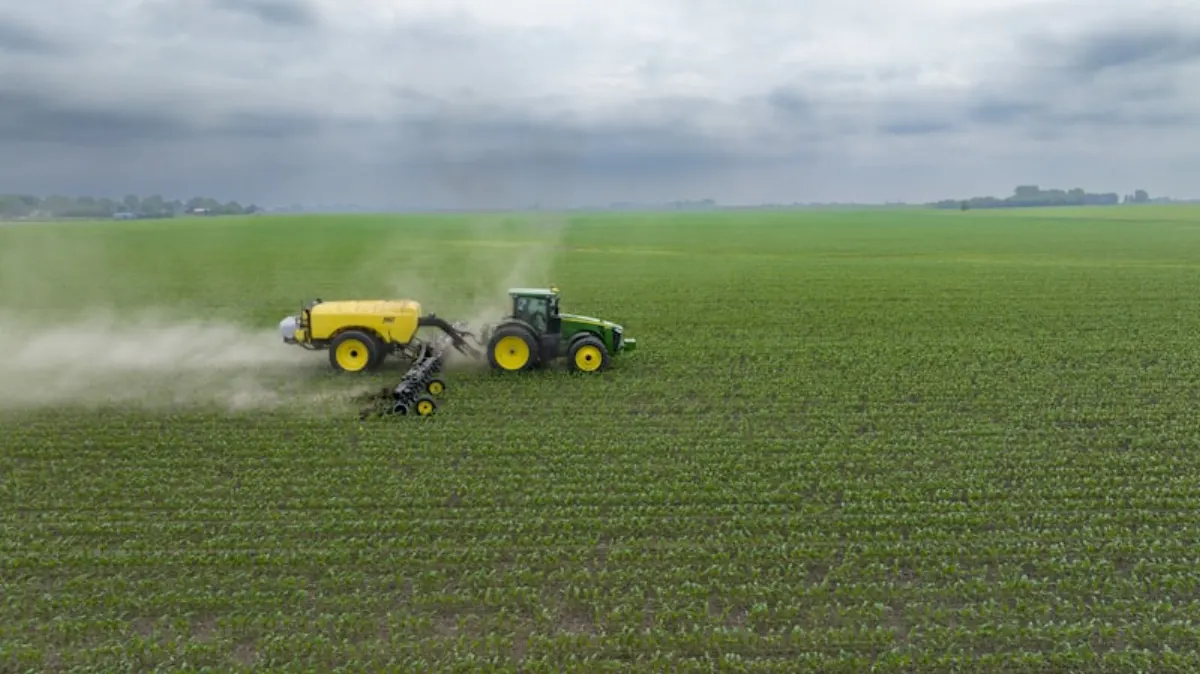
Controlled-release products can reduce the number of fertilizer passes and reduce the losses that occur when a large dose is available at once. They are most useful where the crop has a long season, where wet periods are common, or where labour and machinery are limited. In these situations, one well-chosen application can replace two or three separate top-dressings, saving fuel and time.
They do not replace the soil test, and they do not change the total nutrient budget. A grower still needs to estimate what the crop will take up and what the soil will supply, and then choose a product whose release pattern matches that need. Applying a controlled-release product at a rate that is too high creates the same risk of salt damage and surplus as any other fertilizer, and it can be harder to correct once the nutrient has been released.
Placement and application
Placement affects release as well as uptake. A coated granule placed in a band close to the root zone is in contact with moist soil and roots, so release is well matched to uptake. A granule broadcast on the soil surface may release into the wrong layer or be exposed to drying, depending on the weather. Incorporating the product into the soil where the system allows usually improves the match.
Application equipment also matters. Coated granules are harder than some standard products, but they can be damaged by aggressive spreaders or by long handling. Check that the granules are not crushed or dust-coated during handling, because cracked coatings release nutrient too fast and lose the benefit of the design.

Checking the performance in your field
The best test of a controlled-release product is a comparison in your own field. Include a standard product and an untreated control at the same rate, and record yield and tissue nutrient levels at key growth stages. A single season gives a first indication, but two seasons are more reliable, because the weather varies greatly from year to year.
- Use replicated plots rather than a single strip, so that the result is not influenced by a patch of soil.
- Record soil moisture and temperature, because they drive the release rate and the results depend on them.
- Compare the cost per kilogram of nutrient taken up by the crop, not the price per bag.
- Keep the technical data and the trial records together, so the claims made in sales material can be checked.
Common questions
Will a controlled-release product stop losses completely? No. It reduces losses by slowing release, but some nutrient can still be lost through leaching, runoff or fixation if the rate is too high or the weather is extreme. Good placement and a sound rate remain important.
Is controlled release the same as a stabilized fertilizer? No. A controlled-release product limits the release of the nutrient from the granule. A stabilized fertilizer contains an inhibitor that slows a chemical conversion in the soil, such as the conversion of urea or ammonium. The two approaches can be combined in one product, but they address different parts of the loss process.
Does the coating remain in the soil? Most coatings are designed to break down or be absorbed over time, and the residues are checked in regulatory testing. The product literature should describe the coating material and its fate in the soil, and any questions should be referred to the manufacturer.
Can I mix a coated product with other fertilizers? Check the compatibility on the label and run a small test before mixing in a blend. Some coatings can be damaged by abrasive blends or by long storage in humid conditions, which reduces the release control.
- International Fertilizer Association (IFA), Fertilizer 101 educational series on controlled-release and stabilized fertilizers.
- Shaviv, A., published work on controlled-release fertilizers and release mechanisms (academic literature).
- Published reviews on polymer-coated fertilizers and nutrient release modelling.
- Kingenta internal technical data on KingCote release behaviour (to be confirmed before publication).
Recommendations depend on local soil, climate and crop conditions. Follow the product label and local regulations, and consult a qualified agronomist for field decisions.